Blogs / Collector Notes
Breitling Pluton Team 60: The Forgotten Limited Chronograph
11 min read · 11/5/2026
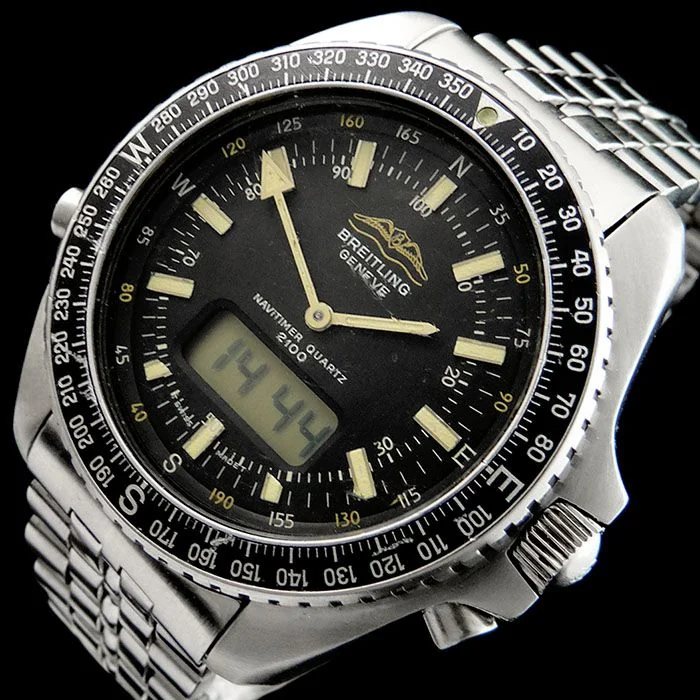
The Breitling Pluton Team 60 is a rarely discussed 1990s aviation watch that combines analogue timekeeping with digital functions and a connection to Sweden’s aerobatic display team. Limited to 1,000 pieces, it represents a different side of Breitling’s professional-watch history—one built around electronic functionality rather than a traditional mechanical chronograph.
Breitling Pluton Team 60: The Forgotten Limited Chronograph
Spend enough time exploring vintage Breitling and a familiar pattern begins to emerge. The Navitimer gets the attention, the Chronomat has its devoted following, and the Aerospace has become a reference point for multifunction pilot’s watches. Then there are the models that seem to live just outside the spotlight.
The Breitling Pluton Team 60 is one of them.
Produced during the 1990s, the Pluton Team 60 combined a quartz movement, analogue hands, and a digital display in a substantial steel aviation watch. Its Team 60 identity connected it to Sweden’s aerobatic display tradition, while its multifunction design reflected a period when Breitling was developing electronic watches as practical instruments for people who wanted more than a conventional three-hand watch.
The Team 60 edition is generally identified by reference A51038 and a limited production of 1,000 pieces. It is not the kind of watch that dominates vintage-watch conversations, but that relative obscurity is part of its appeal. The Pluton shows a side of Breitling history that is easy to miss when attention stays fixed on mechanical chronographs.
What Was the Breitling Pluton?
The Pluton belonged to Breitling’s electronic aviation-watch lineage. Rather than relying on a traditional mechanical chronograph movement, it used quartz technology to combine analogue timekeeping with digital information and additional functions.
The design was firmly in the instrument-watch tradition. A robust steel case, a prominent bezel, clearly legible hands, and a digital display made the watch look purposeful rather than decorative. It was intended to be read and operated as a multifunction tool, with its controls allowing the wearer to access information beyond the standard hours, minutes, and seconds.
The Pluton also needs to be understood within the broader development of Breitling’s ana-digi watches. The brand explored electronic aviation watches during the 1980s and 1990s, including models that combined analogue time display with LCD functions. The Pluton sits within that history, alongside—but distinct from—other electronic models such as the Aerospace, Jupiter, and later professional instruments.
That distinction matters for collectors. These watches may share a design philosophy, but they are not interchangeable models. Their references, displays, movements, and control layouts must be checked individually.
Team 60: The Swedish Aviation Connection
The Team 60 edition gives the Pluton a more specific identity than the standard model. Team 60 is associated with Sweden’s military aerobatic display tradition, and the watch’s special-edition treatment connects Breitling’s aviation-instrument aesthetic with that team.
On documented examples, the blue dial and Team 60 insignia are among the most immediately recognizable features. The edition is also identified by numbered examples from a production run of 1,000 pieces. The numbered limitation gives the watch a defined place in Breitling’s catalogue, even though it has received far less mainstream attention than many of the brand’s better-known professional watches.
It is important not to overstate the military connection. The Team 60 association makes this a watch with an aviation-display-team story, but that alone does not establish that it was officially issued to pilots or used as operational equipment by the Swedish Air Force. A commemorative or collaborative edition and an officially issued service watch are two different things.
For collectors, the most convincing examples are those accompanied by documentation that matches the watch, including the reference and edition number. Original packaging, paperwork, or Team 60-related memorabilia can strengthen the story, but each item should be assessed on its own merits.
The A51038: What Makes This Limited Edition Distinctive?
The Team 60 is commonly associated with the Breitling Pluton reference A51038. Surviving examples and specialist listings describe a stainless-steel case measuring approximately 41 mm across, a blue dial on many Team 60 examples, and a steel bracelet.
Measurements vary slightly between published listings, and case dimensions may be reported differently depending on whether the crown or other projections are included. The safest approach is to treat approximately 41 mm as a useful reference point rather than an exact measurement for every example.
The watch’s display is central to its identity. Analogue hands provide the familiar primary time display, while an LCD window supplies additional information. Depending on the function selected, the digital system can provide information such as a second time zone, calendar information, and an alarm. Published descriptions also identify chronograph functionality.
This is not simply a conventional quartz watch with a decorative screen. The digital display is part of the watch’s practical functionality, and its condition is one of the most important things a buyer should assess.
The B232 Quartz Movement and Its Functions
Collector and dealer documentation identifies the A51038 with Breitling Caliber B232, a quartz movement. That designation is an important part of the model’s identity, but the movement should still be verified on an actual watch when possible, particularly if the watch has a long or uncertain service history.
The Pluton’s multifunction approach combines analogue timekeeping with electronic functions. Depending on the selected mode and the exact configuration, the wearer can access chronograph timing, a second time zone, calendar information, and an alarm. This made the Pluton a different proposition from a traditional mechanical chronograph: its versatility came from an electronic module and digital interface rather than a purely mechanical timing system.
That distinction also affects ownership today. A mechanical chronograph may need an expensive overhaul, but an ageing multifunction quartz watch can present a different problem if the electronic display, circuit, or control system stops working. A watch that keeps time with its hands but has a failed digital display is not functioning as intended.
For that reason, collectors should not judge the Pluton solely by whether its analogue hands are moving. Every digital mode should be tested, including the chronograph, alarm, calendar, and second-time-zone functions. Button operation, display contrast, and the response of the digital system all matter.
Why the Pluton Team 60 Is So Often Overlooked
The first reason is simple: it does not fit the standard image of a vintage Breitling chronograph.
Many collectors come to Breitling through mechanical watches. They are drawn to automatic chronographs, familiar movement names, visible mechanical complexity, and the long history of aviation slide rules. The Pluton takes a different route. Its quartz movement and digital display place it in a more technology-focused corner of the brand’s history.
The second reason is that its design belongs to a specific era. In the 1990s, ana-digi watches offered a compelling blend of analogue familiarity and electronic convenience. Today, smartphones and inexpensive digital devices perform many of the same informational tasks, making the original promise of a multifunction LCD watch less obvious to a casual buyer. But the Pluton’s appeal is not simply about the functions it can perform. It is also a snapshot of how watchmakers approached the needs of aviation enthusiasts before connected devices became commonplace.
The third reason is visibility. The Pluton Team 60 does not enjoy the same volume of editorial coverage, enthusiast discussion, or market attention as the Navitimer. Fewer widely available articles mean that buyers may encounter inconsistent specifications or listings that repeat details from another version of the Pluton. That scarcity of reliable information makes careful research particularly important.
In other words, the watch is overlooked partly because it is unusual—and partly because unusual models require more effort to research.
How to Identify a Genuine Team 60 Example
A Team 60 emblem and blue dial are useful clues, but neither should be treated as conclusive proof. The best approach is to build an identification from several independent details.
1. Check the reference
Start with A51038 and compare the watch with documented examples of the Team 60 edition. Make sure the case, dial, controls, and display configuration match the claimed model. Be cautious when a listing uses “Pluton,” “Navitimer Pluton,” and “Team 60” interchangeably without providing a complete reference or clear photographs.
2. Inspect the Team 60 markings
Look closely at the dial insignia and any limited-edition numbering or associated engravings. Photographs should be sharp enough to distinguish original printing and markings from wear, poor reproduction, or damage. The insignia is part of the watch’s identity, but it should be evaluated alongside the reference and the rest of the configuration.
3. Test every electronic function
This is one of the most important checks. Confirm that the digital display activates correctly, that the buttons respond, and that the chronograph and other available functions work. Check the alarm and second-time-zone operation rather than assuming they are functional because the screen lights up.
Ask the seller whether the watch has had recent battery service and whether any seals or electronic components were replaced. If the digital display is blank, incomplete, or intermittently working, do not assume that a battery change will necessarily fix it.
4. Examine the case and bracelet
Look for excessive polishing, damaged bezel markings, worn bracelet links, and signs of impact around the case and pushers. A vintage watch may show honest wear, but heavy refinishing can soften the edges and alter the original appearance. Check the bracelet and clasp for compatibility with the reference rather than assuming that any Breitling bracelet is correct.
5. Review the papers and edition number
The limited production of 1,000 pieces makes original numbering and documentation worth checking. Request clear photographs of the actual watch’s edition number, papers, and any original box or related Team 60 material. The details should agree with one another.
Do not assume that a box, certificate, or insignia automatically authenticates the watch. Accessories can be separated from their original owners, and a limited-edition number should always be considered alongside the watch’s physical condition and reference details.
Crystal and Specification Differences: Be Careful with Listings
One challenge when researching older Pluton watches is that surviving listings do not always agree on the details. For example, some descriptions identify sapphire crystal, while other vintage references describe mineral glass. Case measurements can also vary between listings.
These differences should not be quietly reconciled into one universal specification without reference-specific evidence. The crystal may depend on the exact version, a replacement fitted during service, or an inaccurate listing. A watch that has been serviced over the decades may no longer retain every original component.
For a collector considering a purchase, the practical answer is to inspect the actual watch and its documentation. If crystal material matters to you, ask for a reliable reference-specific specification and check whether the crystal has been replaced. The same rule applies to case dimensions, bracelet details, and any claimed factory configuration.
Buying a Pluton Team 60 Today
The Pluton Team 60 is best approached as a specialist vintage electronic watch rather than as a conventional mechanical chronograph. That changes the questions worth asking before money changes hands.
- Confirm the exact model: verify the A51038 reference and the Team 60 edition details.
- Test the complete display: analogue timekeeping alone is not enough.
- Check all functions: chronograph, alarm, calendar, and second-time-zone features should be tested where applicable.
- Ask about battery and service history: request details of previous work and any known electronic faults.
- Inspect the case and bracelet: look for polishing, damage, replacement parts, and mismatched components.
- Verify the limited-edition number: compare the watch, certificate, and other documentation.
- Consider repairability: before buying a non-functioning example, ask a watchmaker experienced with vintage Breitling quartz instruments whether parts or service options are available.
Original box and papers can be desirable, but condition and function should remain central to the decision. A complete set with a failed LCD display may be less appealing than a correctly functioning watch with less packaging, depending on the collector’s priorities.
The Pluton’s Place in Breitling History
The Pluton Team 60 deserves attention because it captures a different expression of Breitling’s aviation identity. The Navitimer uses its circular slide rule to connect watchmaking with flight calculations. The Aerospace and related electronic watches emphasize multifunction convenience. The Pluton occupies its own place within that wider story, combining analogue readability with a digital interface and a dedicated limited-edition connection to aerobatic aviation.
It may not offer the familiar romance of a hand-finished mechanical movement, and it will not be the right vintage Breitling for every collector. But its technology, distinctive display, and Team 60 association make it a meaningful example of the brand’s electronic-watch era.
Final Thoughts: A Forgotten Breitling Worth Rediscovering
The Breitling Pluton Team 60 is easy to miss if your collecting interests begin and end with mechanical chronographs. Look closer, however, and it offers a compelling combination of 1990s design, quartz functionality, aviation identity, and limited-edition character.
Its story is also a reminder that a watch does not need to be the most famous model in a brand’s history to be interesting. The Pluton reflects a period when watchmakers were rethinking how a wristwatch could function as a compact instrument, blending analogue hands with digital information in a single package.
For collectors, the most important rule is straightforward: verify the reference, inspect the Team 60 details, and test the electronic functions carefully. A fully functioning example can offer a rewarding look at a less familiar side of Breitling. A watch with a dead display deserves more caution, regardless of how attractive its limited-edition story may be.
That is what makes the Pluton Team 60 worth revisiting. It is not simply a forgotten chronograph. It is a reminder that Breitling’s aviation-watch history has always included more than mechanical movements and circular slide rules.
Watches in this story

Seiko
Seiko Chronograph 821817 Blue Dial Stainless Steel Watch – Running
Ref. 7T92-0CF0 / SND255
$180
Not in Stock — Estimated Delivery 3–4 Weeks

Breitling
Breitling Navitimer B01 Chronograph 43 Japan Limited (100-piece edition)
2016 • Excellent
$8,000
Not in Stock — Estimated Delivery 3–4 Weeks