Blogs / Buying Guides
Omega De Ville Quartz: When the Dress Watch Entered the Quartz Age
8 min read · 10/8/2026
A vintage Omega De Ville Quartz captures the moment Swiss watchmaking entered the electronic age. With its gold tone case, minimalist two hand dial and mesh bracelet, the watch shows how quartz technology influenced not only movements but also the proportions, styling and character of vintage dress watches.
Omega De Ville Quartz: When the Dress Watch Entered the Quartz Age
There was a period when quartz wasn't the inexpensive alternative to a mechanical watch.
It was the future.
Swiss watchmakers had spent generations perfecting mechanical movements when electronic timekeeping suddenly promised extraordinary accuracy, new case proportions and an entirely different direction for wristwatch design.
Omega embraced that change.
And this vintage Omega De Ville Quartz captures the period beautifully.
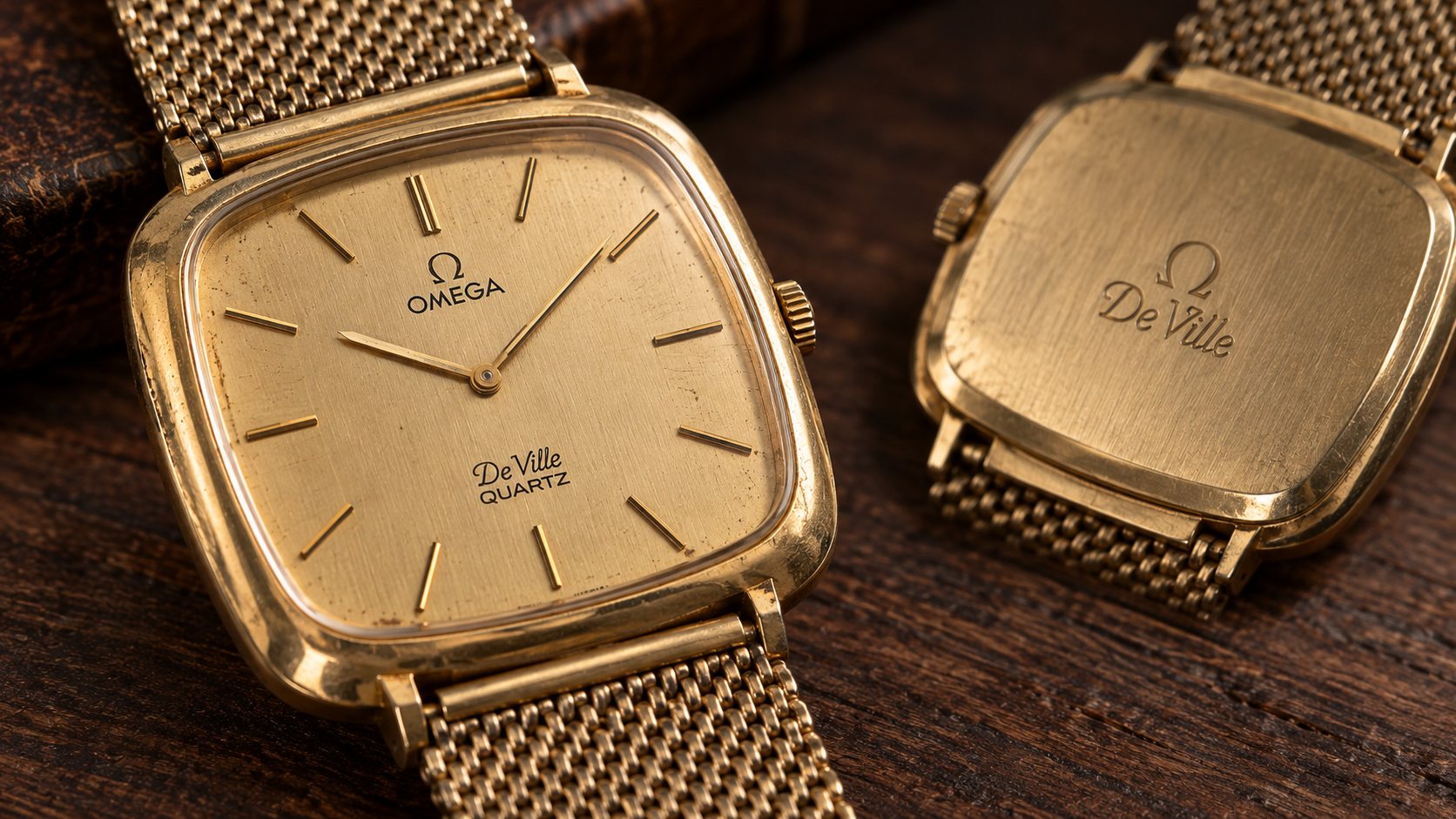
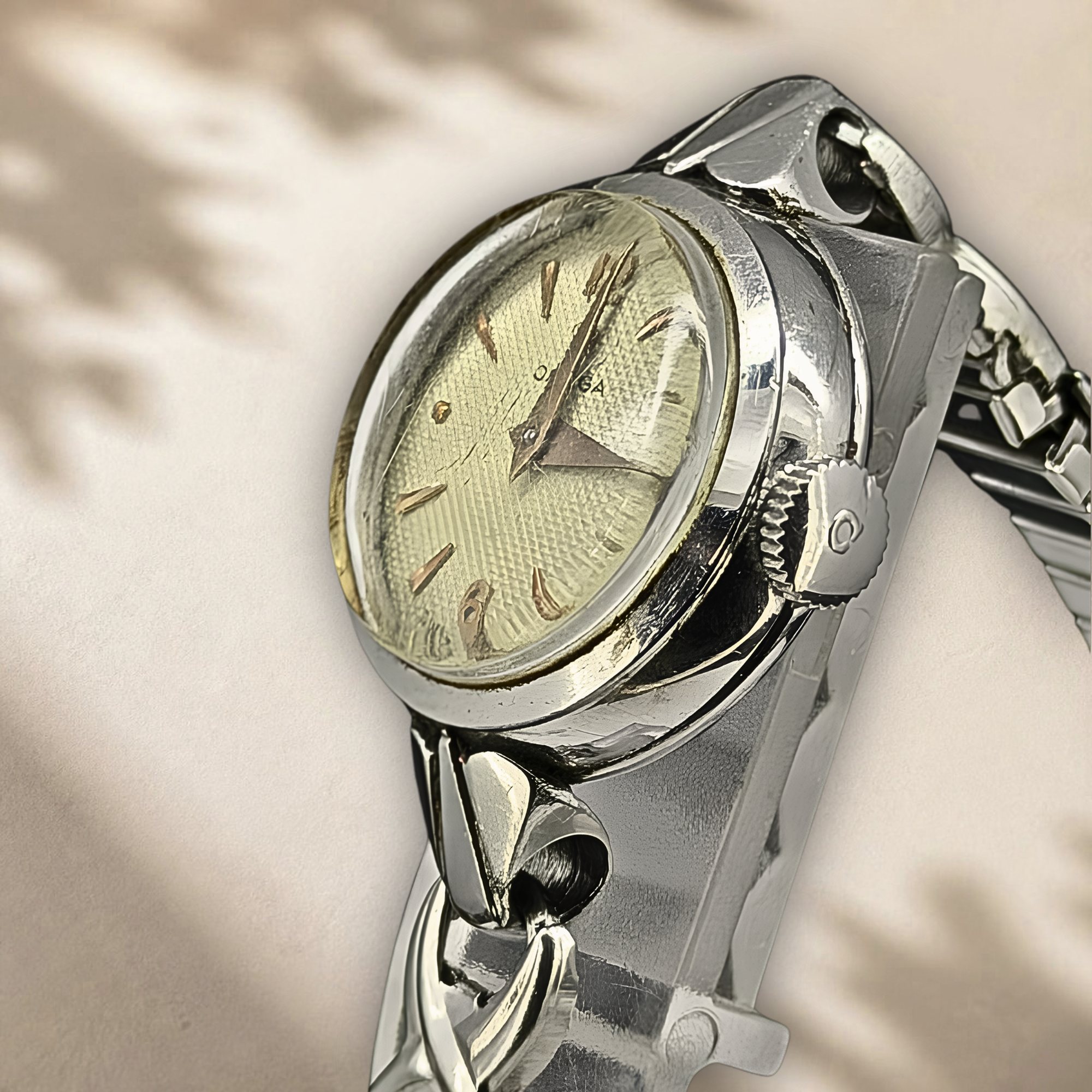
With its gold tone case, matching dial, minimalist two hand display and elegant mesh bracelet, this isn't a quartz watch trying to imitate an older mechanical watch.
It looks like a product of an industry discovering something new.
The De Ville Was an Ideal Platform for Change
Omega's De Ville collection has long occupied the more elegant side of the company's catalog.
Where the Seamaster became associated with water and the Speedmaster with chronographs and motorsport, the De Ville could concentrate on refinement.
Quartz technology fit naturally into that philosophy.
An electronic movement didn't need the same architecture as a traditional mechanical caliber, giving designers greater freedom to experiment with thinner watches and different case proportions.
The watch pictured here shows that change particularly well.
Instead of a traditional round case, it uses a softly squared, almost cushion shaped profile with rounded corners.
The design is distinctly vintage without being ornate.
Omega's own vintage records show that De Ville models were being produced with electronic quartz movements during the late 1970s, including watches powered by Caliber 1330. :chatgpt-content-reference{index="4"}
Gold on Gold
The most immediately noticeable feature is the color.
The case, dial and bracelet all share warm gold tones, producing an almost monochromatic appearance.
Against that background, Omega kept the dial remarkably simple.
Twelve narrow baton markers indicate the hours. Two thin hands provide the time. There is no seconds hand and no date window competing for attention.
At twelve sits the familiar Omega symbol and name.
At six:
De Ville
QUARTZ
That's essentially it.
The absence of additional information gives the dial room to breathe and makes the shape and color of the watch more important than any individual complication.
A Very Different Kind of Quartz Watch
Modern experience can distort the way we think about vintage quartz.
Today, an inexpensive quartz movement can be mass produced in enormous quantities. Because of that, it's easy to look backward and assume quartz was always the inexpensive option.
It wasn't.
During the early quartz era, electronic wristwatches represented advanced technology. Major Swiss manufacturers invested substantial resources developing electronic movements as the traditional watch industry confronted one of the largest technological changes in its history.
Omega was among the Swiss manufacturers developing its own electronic quartz technology.
Omega's technical documentation for Caliber 1330 dates the movement to 1976, placing it firmly within this period of technological transition. :chatgpt-content-reference{index="5"}
For companies such as Omega, quartz wasn't simply about making a cheaper watch.
It was about participating in the next generation of timekeeping.
That historical context makes early Swiss quartz watches much more interesting than their modern reputation sometimes suggests.
The Bracelet Deserves a Closer Look
The bracelet on this particular watch is nearly as visually important as the watch itself.
Rather than a conventional link bracelet, it uses a tightly woven mesh construction.
The result is almost textile like.
Viewed closely, the repeating metal elements create a flexible metallic surface. The bracelet complements the watch's elegant character while giving the entire piece a distinctly period appearance.
There is another detail worth documenting.
The bracelet fitting is visibly marked ELWITZ.
That's exactly the sort of detail we like to record when examining vintage watches.
A vintage watch may have accumulated replacement straps, bracelets, clasps, crowns and other components over decades of ownership. Rather than assuming that every component currently attached to a watch left the factory with it, identifying individual markings allows collectors to investigate those components separately.
That is part of understanding the watch's history.
Unless the bracelet's provenance can be established, it is better to describe the visible marking without automatically calling the bracelet an original Omega component.
What Does "1330" Mean?
Turn the watch over and another number appears:
1330
It's tempting to see a number on a vintage Omega and immediately assign it to a movement caliber or reference.
We wouldn't do that without further evidence.
There is, however, an interesting connection.
Omega's own vintage records confirm that the company used Caliber 1330 in De Ville quartz watches during the late 1970s. For example, Omega documents the De Ville reference ST 191.0073 from 1979 to 1980 with the electronic quartz Caliber 1330. Omega also documents a 1977 solid yellow gold De Ville reference using the same caliber. :chatgpt-content-reference{index="6"}
That makes 1330 a very relevant clue.
But a clue is not the same thing as proof.
The visible marking alone does not allow us to conclusively identify the movement inside this particular watch.
Opening the watch and documenting the movement, movement markings and inside caseback would give us substantially more information.
Until then, 1330 is a documented clue, not a conclusion we need to force.
That's an important distinction when researching vintage watches.
The Two Hand Dial Changes the Personality
One of my favorite characteristics of this particular De Ville is something that isn't there:
A seconds hand.
The two hand arrangement makes the watch feel remarkably calm.
There is no hand constantly moving around the dial. At a glance, you simply see the hour and minute.
For a dress watch, that works beautifully.
It also creates an interesting contrast with mechanical watch collecting, where enthusiasts often watch the seconds hand because its motion provides visual evidence that the mechanical movement is alive.
This De Ville doesn't need that theater.
Its purpose is simply to tell the time elegantly.
Look Closely at the Condition
This isn't a museum perfect watch.
And that's useful.
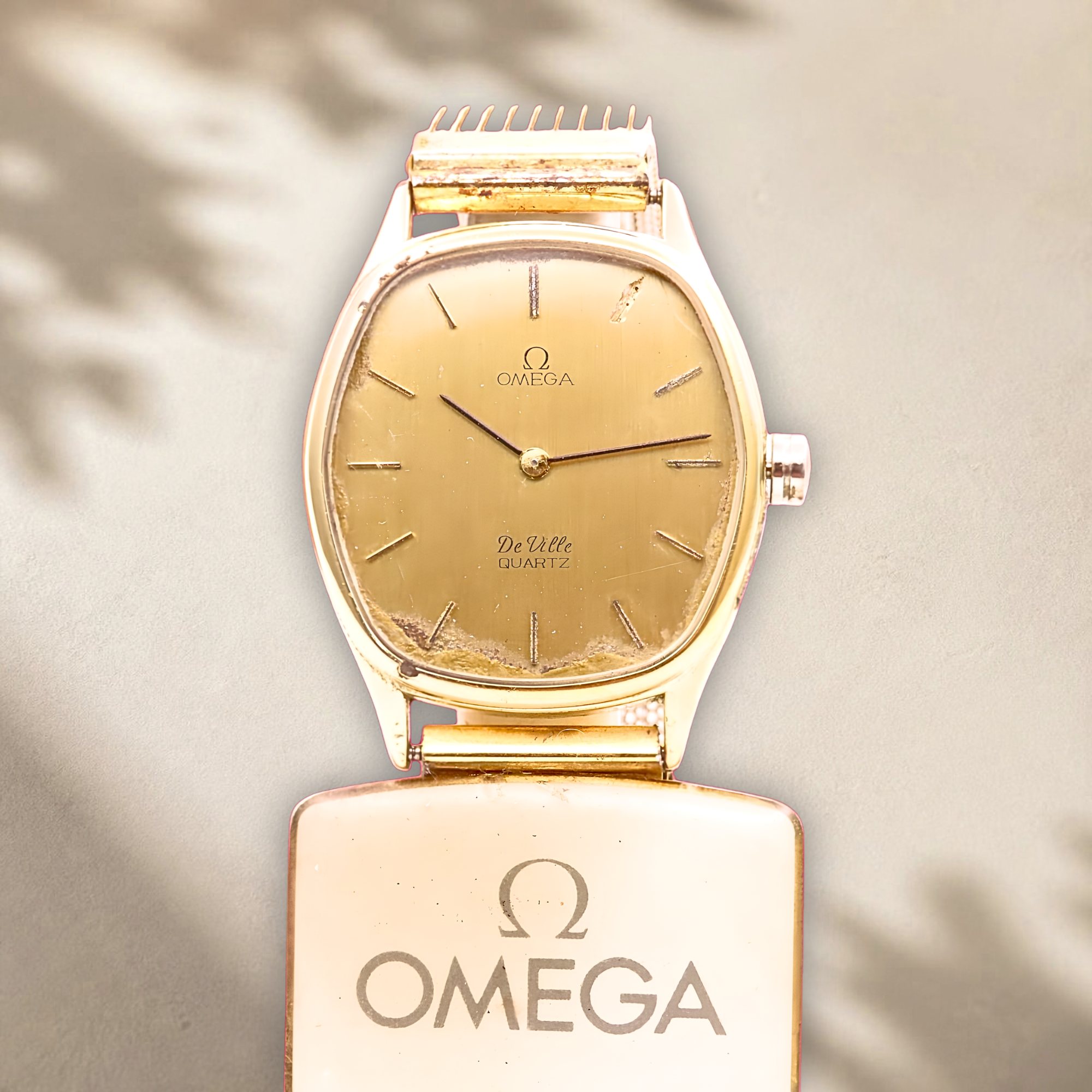
The photographs reveal visible aging and wear, particularly around portions of the dial and case. The bracelet and its attachment points also deserve inspection.
Rather than hiding those details, good vintage watch photography should show them.
A watch that has survived several decades shouldn't automatically be expected to look new.
The important questions are different:
What is original?
What has been replaced?
What has been restored?
What has simply aged?
And what can we actually prove?
Those questions tell us much more about a vintage watch than simply describing it as being in excellent condition.
Quartz Changed More Than the Movement
Perhaps the most interesting thing about this Omega is that quartz technology influenced more than what was inside the case.
It influenced design.
The softly squared case, minimalist two hand dial, monochromatic gold appearance and fine mesh bracelet combine to produce a watch that belongs unmistakably to its period.
Compare it with an earlier round mechanical Omega dress watch and the transformation becomes obvious.
The traditional Swiss wristwatch was changing.
Technology was changing.
Fashion was changing.
And companies like Omega were changing with them.
Why Early Omega Quartz Deserves Another Look
Mechanical watches will probably always dominate vintage collecting.
There is something inherently compelling about gears, springs, escapements and a movement that can operate for decades without electronics.
But that shouldn't make quartz history invisible.
Early quartz watches document one of the most important technological disruptions the watch industry ever experienced.
Some traditional Swiss manufacturers struggled enormously during that transition.
Others experimented.
Omega experimented too, developing electronic quartz movements during the 1970s. The Caliber 1330 is one documented example of that work. :chatgpt-content-reference{index="7"}
That makes watches like this important pieces of the company's broader history.
A Watch From the Future, Now Vintage
There is something wonderfully ironic about an early quartz Omega today.
It was created using technology that represented the future of watchmaking.
Now it is vintage.
The technology that once seemed revolutionary eventually became commonplace, while mechanical watches, the technology quartz was expected to replace, survived and became increasingly associated with luxury and collecting.
That reversal makes early quartz watches even more interesting in retrospect.
This Omega De Ville isn't merely an old battery powered watch.
It is evidence of a moment when one of Switzerland's great watch manufacturers was adapting to an entirely new technological world.
And more than four decades later, we can still hold that moment in our hands.
That's exactly the kind of history we enjoy finding at The Aviators Watch.
Final Thoughts
The vintage Omega De Ville Quartz represents an interesting moment in the history of Swiss watchmaking.
Its minimalist two hand dial, softly squared case, gold tone appearance and mesh bracelet show how the arrival of quartz coincided with new approaches to dress watch design.
More importantly, the watch reminds us that vintage collecting isn't always about the most famous reference or the most complicated movement.
Sometimes the most interesting watches are the ones that capture a transition.
This De Ville captures one of those moments.
A period when quartz represented the future.
A period when Swiss watchmakers were experimenting with new technology.
And a period when even a dress watch could become a small piece of industrial history.