Blogs / Buying Guides
Rolex GMT-Master: The Pilot Watch That Changed How the World Tells Time
10 min read · 10/13/2026
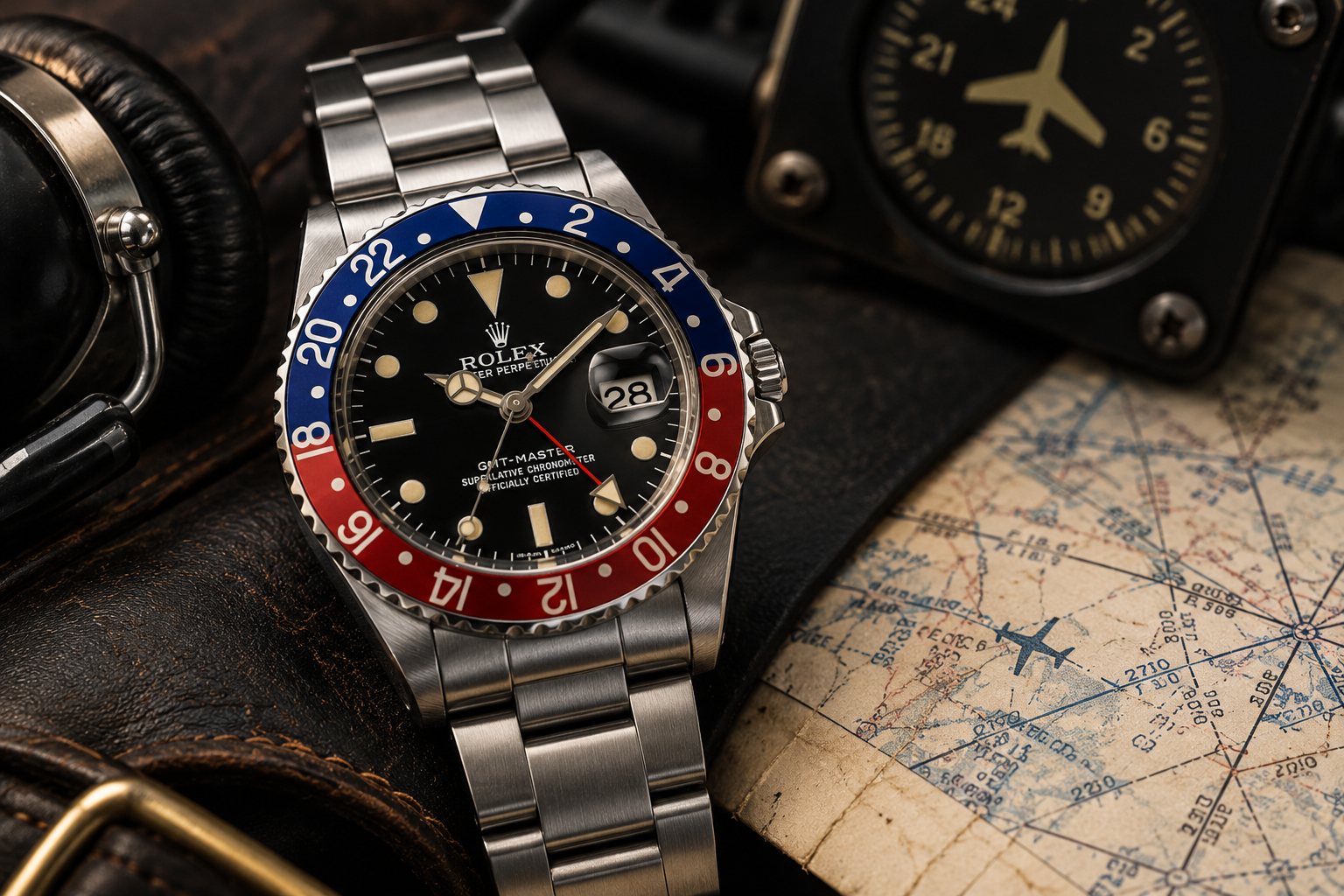
Introduced in 1955 during the rise of intercontinental air travel, the Rolex GMT-Master helped pilots and international travelers keep track of different time zones. Its additional 24-hour hand, rotating bezel, and iconic two-tone designs made it one of the most recognizable watches in history. Explore the GMT-Master's aviation origins, its connection to Pan American World Airways, important reference numbers, and the technical innovations that shaped the GMT-Master II.
Rolex GMT-Master: The Pilot Watch That Changed How the World Tells Time
Some watches become famous because of their design. Others earn their reputation through technical innovation. The Rolex GMT-Master achieved both by solving a practical problem that became increasingly important as aviation connected the world.
During the 1950s, commercial aviation was entering a new era. Aircraft were traveling farther, international routes were expanding, and pilots and airline crews were crossing multiple time zones. Keeping track of local time and the time at another location had become an important part of international travel.
Rolex responded with a watch designed for this new reality. Introduced in 1955, the Rolex GMT-Master combined a conventional time display with an additional 24-hour hand and a rotating bezel marked for 24 hours. This arrangement allowed the wearer to monitor a second time zone without carrying another watch.
The result was more than a recognizable luxury timepiece. It was a practical aviation instrument that eventually became one of the most celebrated travel watches in horology.
Why Was the Rolex GMT-Master Made for Pilots?
The story begins with the rapid growth of long-distance commercial flights during the early jet age.
When an aircraft crosses several time zones, the local time changes while the time at the departure airport or another important location remains relevant. Pilots and airline crews need a reliable way to distinguish between these times.
Rolex developed the GMT-Master as a timekeeping aid for professionals traveling across the globe. The watch became the official timepiece of several airlines, including Pan American World Airways, better known as Pan Am.
Its defining feature was the combination of a dedicated 24-hour hand and a rotating bezel. Together, these allowed the wearer to track another time zone alongside local time.
The watch was also useful to international businesspeople, travelers, and anyone coordinating activities across different parts of the world. Although the GMT-Master was designed with aviation in mind, it was not a replacement for an aircraft's navigation systems or flight instruments.
The History of the Rolex GMT-Master
1955: Reference 6542 Begins the Story
The original Rolex GMT-Master, reference 6542, appeared in 1955. It introduced the defining combination that would shape the collection for decades: an additional hand making one revolution every 24 hours and a bidirectional rotating bezel marked with a 24-hour scale.
Early examples used a plastic bezel insert commonly described as Bakelite. Rolex's historical materials refer to the early inserts as Plexiglas. The red and blue colors helped distinguish daytime and nighttime hours when reading the second time zone.
These early bezel inserts are important to collectors, although their fragility means that originality and condition require careful examination.
1959: Reference 1675 Refines the Design
Rolex introduced the reference 1675 in 1959. It brought a more substantial case with crown guards, helping protect the winding crown.
The reference enjoyed a long production run and appeared in different dial and bezel configurations. Collectors appreciate the variations that emerged over the years, including changes in dial finishes, luminous materials, and bezel inserts.
The 1675 remains one of the most recognizable vintage GMT-Master references.
Early 1980s: Reference 16750
The reference 16750 brought an updated movement and a quickset date function, making date adjustment more convenient. It retained much of the traditional GMT-Master appearance while introducing practical improvements over the previous generation.
1982: The GMT-Master II Arrives
In 1982, Rolex introduced the GMT-Master II with a movement that allowed the local hour hand to be adjusted independently of the other hands.
This made changing time zones much easier. Travelers could adjust the local hour hand in one-hour increments without disturbing the minute hand or the 24-hour reference hand.
The first GMT-Master II was reference 16760, nicknamed the "Fat Lady" by collectors because of its thicker case. The original GMT-Master and GMT-Master II overlapped for a period, so the newer model did not immediately replace the original line.
2005 and Beyond: The Ceramic Bezel Era
Rolex introduced its Cerachrom ceramic bezel insert in the modern GMT-Master II generation, beginning with precious-metal models in 2005. Ceramic bezels later became available on stainless steel versions.
Ceramic is designed to resist scratches and retain its color. Later generations also brought updated movements, refined bracelets, and new bezel combinations.
Despite these changes, the central idea has remained consistent since 1955: a watch designed to keep multiple time zones within reach.
How Does the Rolex GMT-Master Work?
The GMT-Master's function becomes easier to understand when its hands and bezel are considered separately.
The 24-Hour GMT Hand
In addition to the conventional hour, minute, and seconds hands, the watch has a fourth hand with an arrow-shaped tip. This hand completes one full revolution every 24 hours rather than every 12 hours.
Its position can be read against the 24-hour bezel to distinguish morning from evening in the reference time zone. For example, a traveler in Singapore could keep the main hands set to local time while using the GMT hand to monitor the time in New York.
The Rotating 24-Hour Bezel
The bezel provides the scale used to read the GMT hand. On modern GMT-Master II models, it rotates in both directions and has 24-hour graduations.
Many versions feature two contrasting colors to help distinguish daytime and nighttime hours. The famous red and blue combination is known as the "Pepsi" bezel. Other collector nicknames include "Coke" for black and red, "Batman" for blue and black, and "Root Beer" for certain brown and gold or brown and black configurations.
These are informal collector names, not official model names used by Rolex for every configuration.
The Independently Adjustable Local Hour Hand
This is the defining functional difference between the original GMT-Master and the GMT-Master II.
On the original GMT-Master, the conventional hour hand is not independently adjustable in the same way as on the GMT-Master II. The newer model allows the wearer to move the local hour hand forward or backward in one-hour increments without stopping the movement or changing the 24-hour reference hand.
The GMT-Master II can therefore display local time and reference time simultaneously. By rotating the bezel, the wearer can also read a third time zone.
Rolex GMT-Master vs. GMT-Master II
Although their designs are closely related, the two generations differ in how they handle time zones.
Original GMT-Master
- Introduced in 1955.
- Uses an additional 24-hour hand and rotating bezel.
- Does not have the independently adjustable local hour hand introduced with the GMT-Master II.
- Important references include 6542, 1675, 16750, and 16700.
GMT-Master II
- Introduced in 1982.
- Features an independently adjustable local hour hand.
- Makes changing time zones easier for frequent travelers.
- Can display a third time zone by using the bezel with the 24-hour hand.
- Important references include 16760, 16710, 116710, and 126710.
The GMT-Master II offers more flexibility for frequent travelers, while the original GMT-Master remains especially appealing to collectors interested in the model's history.
Important Rolex GMT-Master Reference Numbers
Reference numbers identify particular generations and configurations. However, they do not tell the entire story of an individual watch. Dial variations, bezel inserts, production dates, service parts, and case condition also matter.
Reference 6542: The Original GMT-Master
Introduced in 1955, the 6542 is the first GMT-Master reference. Early examples are notable for their Bakelite or Plexiglas bezel inserts and connection to the birth of the model.
Reference 1675: The Vintage Classic
Produced from 1959 into approximately 1980, the 1675 is one of the best-known vintage GMT-Master references. It introduced crown guards and appeared in numerous dial and bezel configurations.
Reference 16750: A Practical Update
Introduced in the early 1980s, the 16750 brought a newer movement and quickset date functionality while preserving the traditional GMT-Master design.
Reference 16700: A Later Original GMT-Master
The 16700 appeared in the late 1980s and continued the original GMT-Master line after the GMT-Master II had arrived. It demonstrates that the two model lines overlapped rather than one immediately replacing the other.
Reference 16760: The First GMT-Master II
Introduced in 1982, the 16760 was the first GMT-Master II. Its independently adjustable local hour hand established the defining mechanical advantage of the newer generation.
Reference 16710: A Collector Favorite
Produced from the late 1980s until 2007, the 16710 appeared with several bezel styles, including Pepsi, Coke, and all-black configurations.
Reference 116710: The Modern Ceramic Era
The 116710 generation brought ceramic bezel technology and a contemporary case design to the GMT-Master II. The black 116710LN and blue and black 116710BLNR are notable examples.
Reference 126710: A Modern GMT-Master II Generation
The 126710 family includes modern Oystersteel GMT-Master II models with different bezel and bracelet configurations. The 126710BLRO is associated with the red and blue Pepsi bezel, while the 126710BLNR is the blue and black version.
These modern models use Rolex Calibre 3285, which provides the GMT function, automatic winding, and date display. Reference numbers should always be checked against the specific watch and its documentation. Bezel color or a collector nickname alone cannot authenticate a Rolex.
Important Features of the Modern Rolex GMT-Master II
Specifications vary by reference and configuration. The following features describe the modern Oystersteel GMT-Master II reference 126710BLRO.
Rolex Calibre 3285
Calibre 3285 is a self-winding mechanical movement developed and manufactured by Rolex. It includes the GMT function and the independently adjustable local hour hand that defines the GMT-Master II.
Rolex specifies a power reserve of approximately 70 hours.
Bidirectional Ceramic Bezel
The watch features a bidirectional rotating 24-hour bezel with a two-color Cerachrom ceramic insert. The ceramic material is designed to resist scratches and retain its color. Its 24-hour markings allow the wearer to read the time indicated by the GMT hand.
40 mm Oyster Case
The reference 126710BLRO has a 40 mm Oyster case made from Oystersteel. Its screw-down case back and Triplock winding crown contribute to a water resistance rating of 100 meters, or 330 feet, under the conditions specified by Rolex.
Sapphire Crystal and Cyclops Lens
A scratch-resistant sapphire crystal protects the dial. A Cyclops lens above the date magnifies the display for easier reading.
Oyster or Jubilee Bracelet
Depending on the configuration, the reference 126710BLRO is available with an Oyster or Jubilee bracelet. The Oyster bracelet has a sportier appearance, while the Jubilee bracelet offers a more intricate, traditional look.
Rolex Precision Standards
Rolex specifies its Superlative Chronometer standard at minus two to plus two seconds per day for a fully cased watch after casing. This is a manufacturer specification, not a guarantee that every individual watch will perform identically in every condition throughout its life.
Why Is the Rolex GMT-Master Called the Pepsi?
The Pepsi nickname refers to the red and blue bezel found on several GMT-Master and GMT-Master II configurations. The colors are visually distinctive and traditionally help separate daytime and nighttime hours on the 24-hour scale.
The nickname is especially associated with the original GMT-Master design and modern models such as the 126710BLRO. It is not an official Rolex model name.
The Pepsi bezel has become one of the most recognizable designs in watchmaking, connecting modern GMT-Master II watches to the original aviation era.
Other Famous Rolex GMT Bezel Nicknames
- Pepsi: Red and blue bezel.
- Coke: Black and red bezel.
- Batman: Blue and black bezel, commonly associated with the Oyster bracelet version.
- Batgirl: A collector nickname often used for a blue and black bezel model fitted with a Jubilee bracelet.
- Root Beer: A nickname used for certain brown and gold or brown and black bezel configurations.
- Sprite: Green and black bezel on the left-hand crown GMT-Master II configuration.
These nicknames make conversations between collectors easier, but they are not formal reference numbers. Bracelet, material, and reference details are still necessary to identify a particular watch.
Is the Rolex GMT-Master Still Useful for Pilots?
Yes. The GMT-Master's time-zone function remains useful for pilots and frequent travelers. The 24-hour hand makes it possible to track a reference time while the main hands display local time.
Modern aviation, however, relies on sophisticated electronic flight instruments, navigation systems, and established operational procedures. A wristwatch is a supplementary timekeeping tool, not a substitute for those systems.
The GMT-Master's practical advantage today is its ability to make multiple time zones easy to read at a glance. This remains useful for international pilots, airline crews, business travelers, and people who regularly communicate across countries.
Its aviation heritage continues to shape its identity even as the watch has become a luxury travel companion for a much wider audience.
What Should Collectors Check Before Buying a Vintage Rolex GMT-Master?
A vintage GMT-Master can be fascinating, but the reference number is only the starting point.
Watches in this story
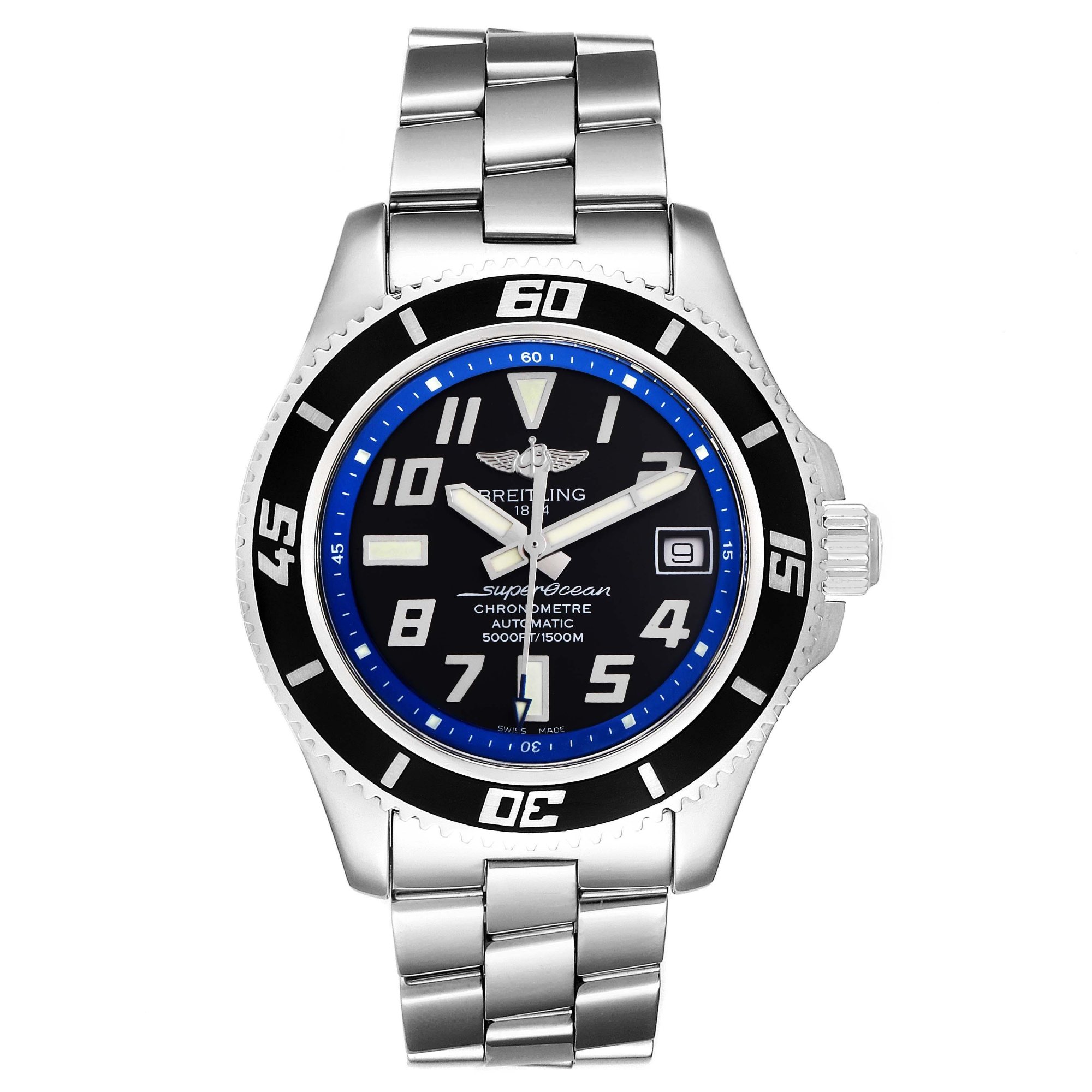
Breitling
Breitling Superocean 42 ("Abyss Blue", Black/blue dial, Black bezel)
Ref. A17364
$2,285
Not in Stock — Estimated Delivery 3–4 Weeks