Blogs / Collector Notes
Steel or Gold? Inside the Breitling Navitimer 50th Anniversary
13 min read · 10/31/2026
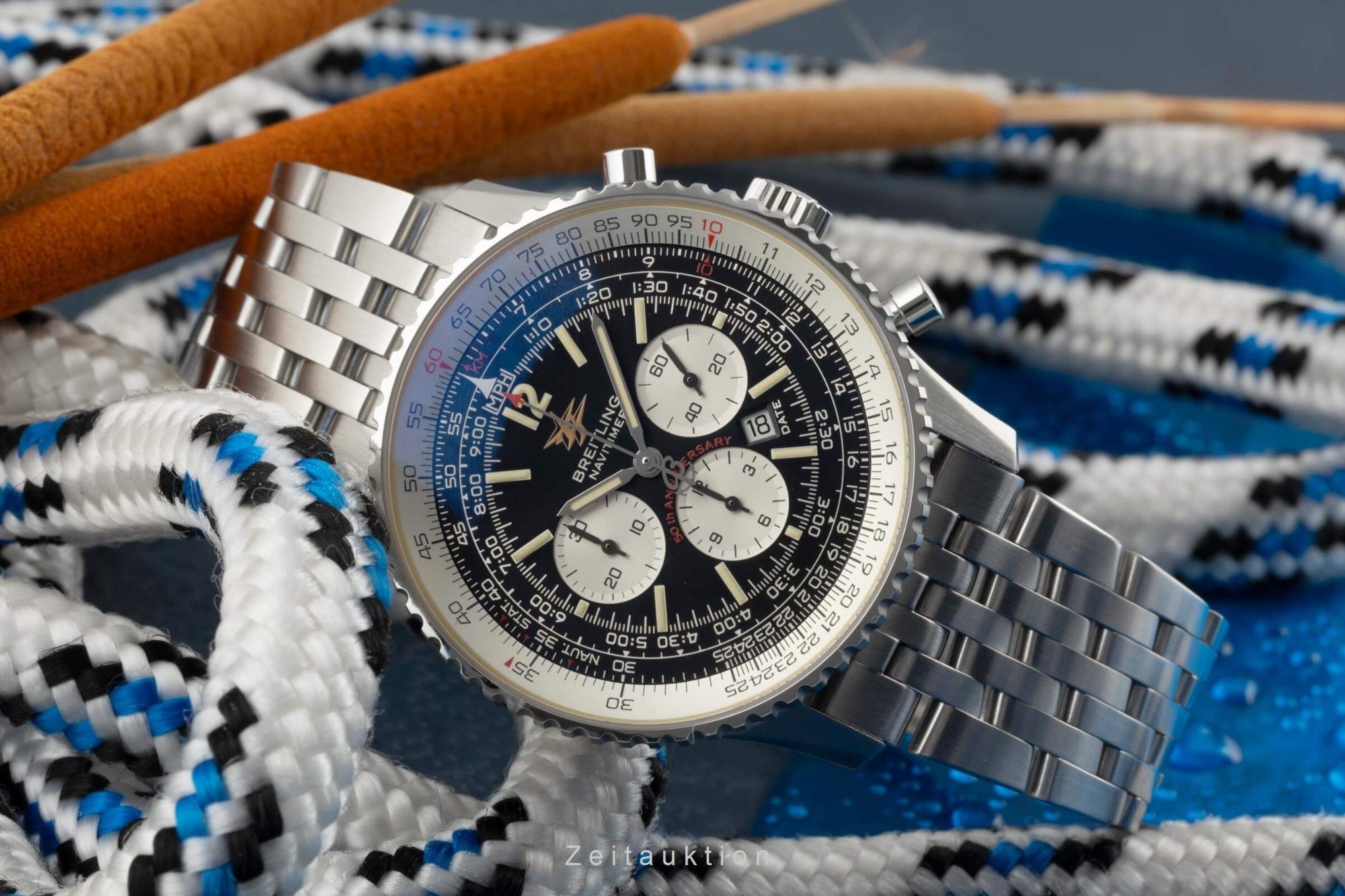
A collector's guide to Breitling's 2002 Navitimer 50th Anniversary, exploring its history, steel and precious-metal references, Caliber 41 movement, caseback engravings, original paperwork, and practical authentication checks.
Steel or Gold? Inside the Breitling Navitimer 50th Anniversary
Some watches celebrate a milestone with a new color or a commemorative inscription. Others use the occasion to reconnect with the history that made them icons in the first place.
The Breitling Navitimer 50th Anniversary belongs to the second group.
Introduced in 2002 to mark half a century of the Navitimer, this special edition celebrated one of the most recognizable aviation chronographs ever made. Its circular slide rule, three-register chronograph layout, and distinctive pilot-watch character remained intact, while anniversary-specific dial details gave it a stronger connection to the model's early history.
But there is more to this watch than the number 50 on a caseback. The anniversary family included stainless-steel and precious-metal versions, and the differences matter to collectors. Reference numbers, case materials, edition markings, and original documentation all help tell the story of an individual example.
So, is the steel version the most faithful expression of the Navitimer's instrument-watch roots? Does a gold example offer a more exclusive interpretation of the anniversary? And what should you check before trusting a seller's claim that a watch is a genuine 2002 limited edition?
Let's look closer.
Why 2002 Was a Milestone for the Navitimer
To understand the anniversary watch, we need to go back to 1952.
Breitling introduced the Navitimer as an aviation-oriented chronograph equipped with a circular slide rule. This rotating scale allowed pilots to perform calculations involving speed, distance, fuel consumption, and unit conversions. In an era when cockpit instrumentation and flight planning were central to the pilot's daily routine, the Navitimer's bezel was more than decoration. It was a functional tool built into the watch.
That purpose shaped the design. The dial was busy because it had work to do. The multiple scales, chronograph counters, and rotating bezel created a technical appearance that became one of the Navitimer's defining characteristics.
Over the following decades, the model developed into one of Breitling's signature collections. Its slide-rule bezel remained central to its identity, even as aviation technology evolved and electronic instruments took over many calculations once performed by hand.
By 2002, the Navitimer had accumulated fifty years of history. The anniversary edition acknowledged that legacy without turning the watch into an entirely different design. It retained the familiar chronograph layout and circular slide rule while introducing details that linked it to the model's heritage.
One of the most distinctive touches was the twin-aircraft Breitling emblem, a historical-style logo that gave the anniversary dial a vintage character. Silver-dial examples with contrasting subdials also helped the anniversary version stand apart from more familiar black-dial Navitimers.
That combination is what makes the watch interesting today. It is recognizably a Navitimer first, with the anniversary details adding another layer of meaning for collectors.
The Anniversary References: Steel, White Gold, Yellow Gold, and Rose Gold
The Navitimer 50th Anniversary is associated with several reference numbers. Identifying the correct one is an important first step when researching or buying an example.
- A41322: Stainless steel.
- J41322: White gold.
- K41322: Yellow gold.
- H41322: Rose gold examples are also documented in specialist watch records.
These references should not be treated as interchangeable. Case material affects the watch's appearance, weight, hallmarks, and collecting appeal. It also changes what a buyer should expect to see when examining the case and accompanying documentation.
The exact configuration matters, too. Dial details, straps, bracelets, clasps, and paperwork may differ between individual examples. A listing that simply says "Navitimer 50th Anniversary" does not tell the whole story.
Stainless steel: The classic instrument-watch character
The Ref. A41322 is a natural choice for collectors who love the Navitimer as an aviation chronograph. Stainless steel complements the busy dial and technical bezel, preserving the practical, tool-like personality that has always made the model distinctive.
Documented examples include silver-toned dials with contrasting dark subdials and the twin-aircraft emblem. The overall effect is technical but balanced, with the anniversary details adding historical interest without overwhelming the familiar design.
Steel may also feel more versatile to someone who intends to wear the watch regularly. It can be paired with a suitable leather strap or compatible Navitimer bracelet, depending on the specific configuration.
For collectors who want the anniversary connection without the more conspicuous presence of precious metal, the steel version makes a strong case for itself.
White gold: Subtle luxury
The Ref. J41322 offers a more understated precious-metal interpretation. White gold can look similar to steel in photographs, which makes reference verification particularly important.
A documented example sold through Christie's was identified as a white-gold Navitimer 50th Anniversary, Ref. J41322, numbered 08/50. It featured a lacquered silver dial and the historical-style twin-aircraft emblem.
This is a useful reminder that the precious-metal anniversary watches are not simply steel watches with a different finish. Their reference, case material, and edition markings are part of their identity.
Yellow gold: A more celebratory presence
The Ref. K41322 is associated with yellow-gold anniversary examples. Compared with steel, yellow gold gives the Navitimer a warmer and more overtly luxurious appearance.
The technical dial and circular slide rule remain the visual center of the watch, but the precious-metal case changes its personality. It feels less like a conventional instrument watch and more like a commemorative chronograph created to mark an important milestone.
That does not automatically make it a better collector's watch. Condition, originality, service history, and reference-specific details still deserve more attention than the material alone.
Rose gold: A distinct precious-metal variant
Specialist records also document rose-gold Navitimer 50th Anniversary examples associated with Ref. H41322. These watches add another option for collectors interested in the anniversary family.
Because listings can use different descriptions for case material and configuration, buyers should verify the exact reference and metal rather than relying on a seller's title or a photograph. For any precious-metal example, hallmarks and professional inspection are especially useful.
Limited Edition Does Not Always Mean the Same Number
The phrase "limited edition" can make a watch sound straightforward: a specific number was produced, and every example should carry a matching edition number.
Real collecting research is not always that simple.
Christie's documented a white-gold Ref. J41322 numbered 08/50, described as one of fifty examples created for the Navitimer's fiftieth anniversary. Other specialist records describe precious-metal anniversary versions with their own individual numbering.
The stainless-steel Ref. A41322 is also documented as a 2002 anniversary edition, but buyers should not assume that its production limit was identical to that of every precious-metal version. Different case materials and references may have different production details.
For this reason, avoid repeating a single production figure across the entire anniversary family unless reliable documentation supports that specific claim.
If a seller advertises a particular watch as "number 12 of 50," ask for a clear photograph of the actual engraving. Then compare the reference, case material, and inscription with trustworthy records for that version. The number should fit the specific watch, not just the general anniversary story.
The Caseback: What Should You Look For?
The caseback is one of the most important places to inspect when evaluating a Navitimer 50th Anniversary.
Documented steel examples carry anniversary wording referring to the Navitimer's fifty-year milestone, including the date range 1952–2002. Auction and dealer records describe casebacks marked with wording such as "NAVITIMER 50 YEARS 1952–2002." Precious-metal examples may carry additional limited-edition wording and individual numbering.
However, do not expect every caseback to be identical across all references. The exact engraving, edition number, and hallmarks must be considered in relation to the case material and reference.
When requesting photographs, ask for:
- A clear image of the entire caseback, not just a close crop of the anniversary wording.
- A readable view of any edition number.
- The reference and serial information available on the watch.
- Hallmarks on precious-metal examples.
- Additional case and movement photographs that allow a specialist to assess consistency.
Look at the overall quality and coherence of the markings. Do the reference and case material make sense together? Does the edition inscription match the seller's description? Are the hallmarks consistent with the claimed metal?
Most importantly, an engraving is not proof of authenticity by itself. Casebacks can be replaced, and markings can be copied. A genuine-looking anniversary inscription cannot compensate for an inconsistent movement, incorrect case, questionable dial, or mismatched documentation.
Original Papers: What Should Accompany the Watch?
Original papers can add useful context to a discontinued watch, but buyers should understand what they actually prove.
Depending on the example and its history, a Navitimer 50th Anniversary may be accompanied by original warranty documentation, a COSC chronometer certificate or attestation, instruction booklets, slide-rule instructions, a presentation box, and service records.
An auction record for a stainless-steel Ref. A41322, for example, describes a watch accompanied by a fitted box, warranty, COSC certificate, and booklets. This demonstrates the types of material that can survive with an example, but it does not mean every original set contained exactly the same items.
A watch without its original box or papers is not automatically inauthentic. After more than two decades, accessories and documents may have been separated from the watch or lost. On the other hand, a complete-looking set does not automatically prove that every component belongs together.
How to check the paperwork
Before buying, compare the information available across the watch and its documents.
- Does the reference match the model and case material?
- Do any recorded serial or reference details correspond with the watch?
- Does the purchase date make sense for a model introduced in 2002?
- Are the documents specific to the watch, or could they belong to another Breitling?
- Do service records identify the watch and provide a coherent maintenance history?
A COSC certificate or chronometer attestation can support the documented history of the watch, but it should not be treated as a stand-alone certificate authenticating every part of the watch as it exists today.
If the seller claims the watch is a "full set," request photographs of every included item. A careful seller should be able to show the documents and explain what is included. For an expensive example, have a qualified Breitling specialist assess the watch independently.
The Movement: Breitling Caliber 41
The anniversary Navitimer is associated with Breitling Caliber 41, an automatic chronograph movement based on the ETA 2892-A2 architecture.
Specialist records list the movement with 38 jewels, COSC chronometer certification, and an approximate power reserve of 42 hours. That means a fully wound movement can run for roughly a day and eighteen hours without receiving additional energy, although the actual performance of an individual watch depends on its condition.
The movement powers the watch's time display, small seconds, date, and chronograph. The circular slide rule operates through the rotating bezel and its scales rather than being an electronic function.
For a pre-owned example, movement condition is just as important as the visible anniversary details. Ask whether the watch has been serviced, whether the seller has documentation, and whether the chronograph starts, stops, and resets correctly.
If service history is unknown, do not assume the watch is ready for daily wear simply because it is running. A qualified watchmaker can inspect the movement, assess its condition, and advise whether servicing is needed.
Watch Specifications
- Brand: Breitling
- Collection: Navitimer
- Model: Navitimer 50th Anniversary
- Anniversary year: 2002
- Milestone: Fifty years since the Navitimer's introduction in 1952
- Known reference family: A41322 (stainless steel), J41322 (white gold), K41322 (yellow gold), H41322 (rose gold examples documented)
- Case diameter: Approximately 41.8 mm in specialist records; some listings round this to 42 mm
- Movement: Breitling Caliber 41, automatic chronograph
- Movement base: ETA 2892-A2 architecture
- Certification: COSC chronometer
- Jewels: 38
- Power reserve: Approximately 42 hours
- Functions: Hours, minutes, small seconds, date, chronograph, circular slide rule
- Chronograph counters: 30-minute and 12-hour registers
- Bezel: Bidirectional rotating bezel with circular slide rule
- Crystal: Sapphire
- Caseback: Screw-down caseback, with anniversary markings depending on reference
- Water resistance: Commonly listed at 30 metres when new
- Dial: Configurations vary; documented anniversary examples include silver dials with contrasting subdials and the twin-aircraft emblem
- Strap or bracelet: Configuration varies by individual watch
Specifications can vary by reference and individual example. Water resistance on a watch from 2002 should be tested by a qualified watchmaker before any exposure to water.
Buying Checklist: How to Assess an Anniversary Navitimer
If you're considering a Navitimer 50th Anniversary, slow down and assess the whole watch rather than focusing on a single commemorative detail.
1. Confirm the exact reference.
Determine whether the watch is A41322, J41322, K41322, H41322, or another specifically documented configuration. Verify that the case material agrees with the reference.
2. Inspect the dial.
Look at the twin-aircraft emblem, subdials, printing, hands, and date window. Check whether the dial matches reliable photographs of the same reference. Dial appearance alone cannot establish authenticity.
3. Examine the caseback.
Request photographs showing the anniversary inscription, edition number where present, and any relevant hallmarks. Compare the details with records for the exact version.
4. Verify the precious metal.
For a gold example, inspect the hallmarks and have the case assessed by a qualified specialist if there is any doubt. Color alone is not proof of solid gold.
5. Match the papers.
Compare the watch's identifying information with its warranty documents, chronometer papers, and service records where available.
6. Check the movement and service history.
Confirm that the movement is consistent with the reference and have the chronograph and timekeeping assessed by a watchmaker.
7. Judge condition and originality.
Look for excessive polishing, damaged or refinished dials, replacement hands, mismatched parts, bracelet wear, and evidence of poor repairs. Replaced components are not always deal-breakers, but they should be disclosed and reflected in the price.
8. Seek independent authentication.
For a high-value purchase, an independent assessment from a watchmaker or specialist familiar with early-2000s Breitling chronographs is a sensible final step.
Do not pay a premium simply because a listing uses the words "rare," "limited," or "full set." Those claims should be supported by the exact reference, condition, documentation, and credible evidence.
Steel or Gold: Which Navitimer 50th Anniversary Is Right for You?
The stainless-steel Ref. A41322 is a compelling choice for someone who wants the Navitimer's classic aviation-instrument character with an anniversary-specific identity. It keeps the emphasis on the technical dial and slide-rule bezel.
The white-gold, yellow-gold, and documented rose-gold versions offer different interpretations of the same milestone. Their precious-metal cases can make the watch feel more celebratory, but they also call for careful verification of reference numbers, hallmarks, and edition markings.
There is no universal winner. The right example is the one that suits your taste, fits your collecting goals, and has a convincing story supported by its condition and documentation.
The anniversary inscription may be what catches your eye first. The more rewarding discovery is how the reference, movement, case, and history fit together.
Final Thoughts: A Fifty-Year Milestone Worth Understanding
The Breitling Navitimer 50th Anniversary is more than a commemorative watch. It connects the 2002 collector to a model introduced in 1952, when a circular slide rule could turn a wristwatch into a practical aviation instrument.
Its anniversary details give the watch a place in the Navitimer story, while the different case materials broaden its appeal. Steel preserves the classic instrument-watch look. Precious-metal examples offer a more luxurious expression of the same milestone.
For collectors, the lesson is simple: understand the exact reference before deciding what a particular watch is worth. Check the caseback, verify the case material, review the papers, and pay attention to condition and service history.
That is how you move beyond the anniversary label and appreciate the watch itself.
Looking for Your Own Navitimer?
Considering a Navitimer 50th Anniversary? Take time to verify the reference and condition, ask for clear caseback and movement photographs, and seek specialist advice whenever the details do not line up. A well-understood watch is always a more rewarding addition to a collection.
Watches in this story
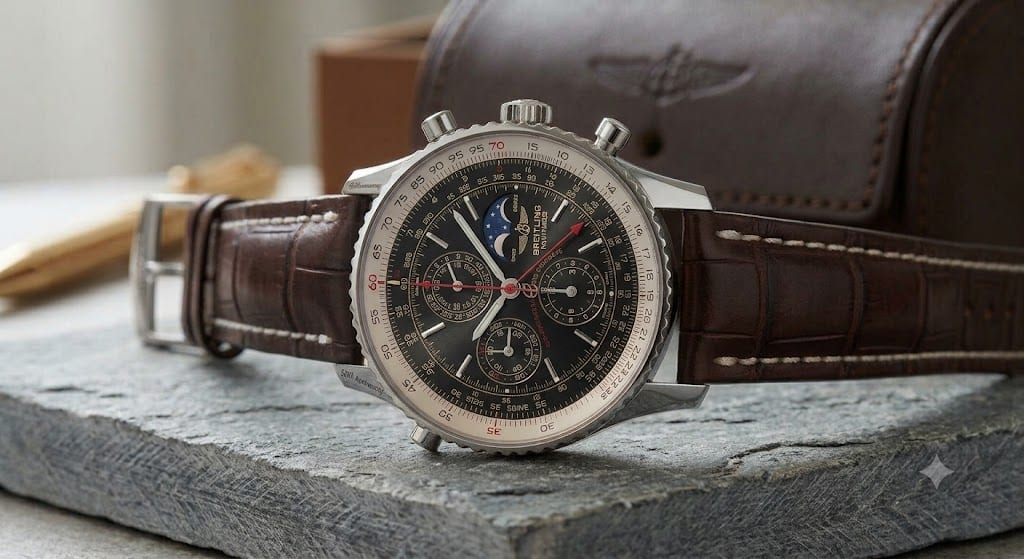
Breitling
Breitling Navitimer 50th Anniversary
Ref. H41322
Call for Pricing
Out of Stock. Call for Pricing
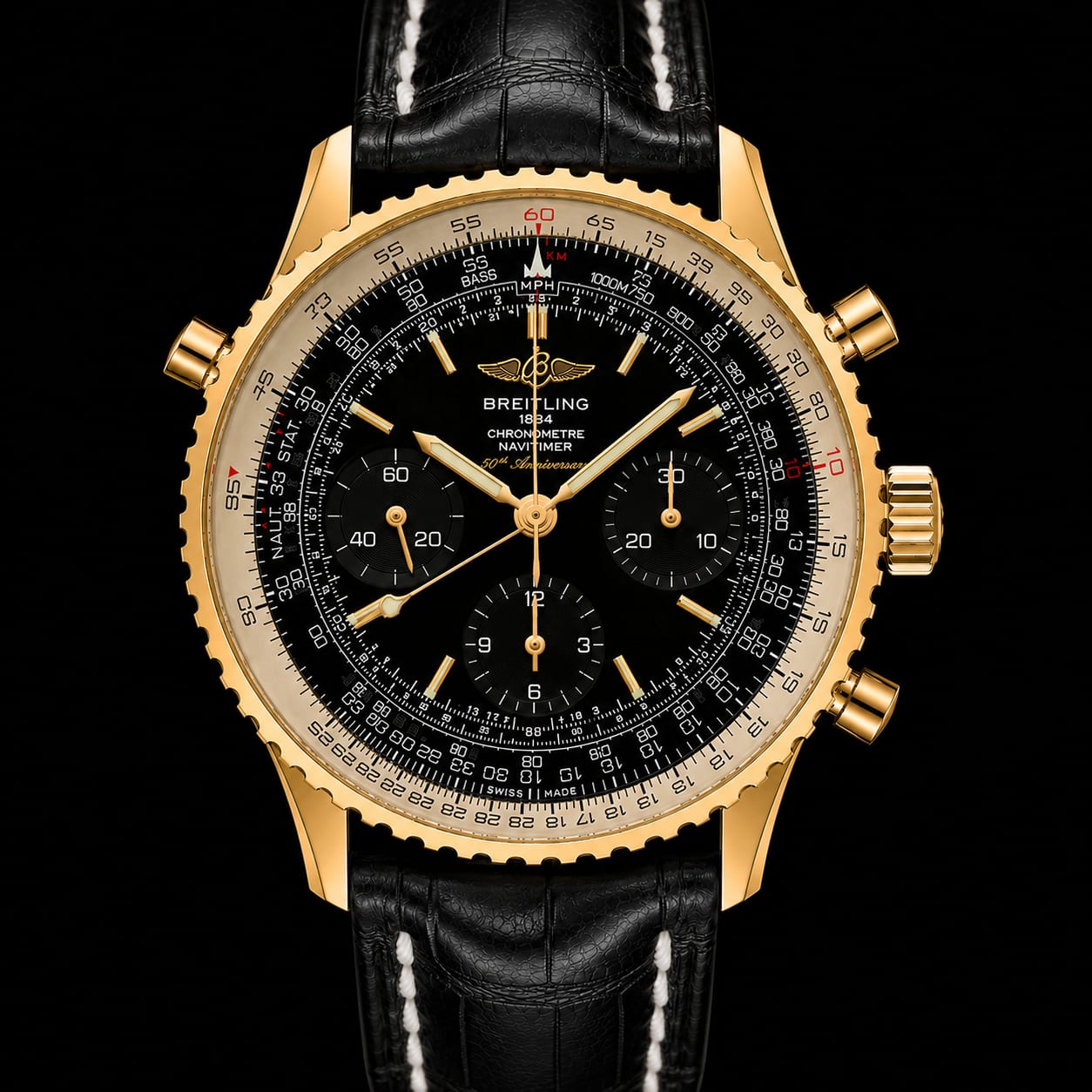
Breitling
Breitling Navitimer 50th Anniversary
Ref. J41322
$18,000
Not in Stock — Estimated Delivery 3–4 Weeks
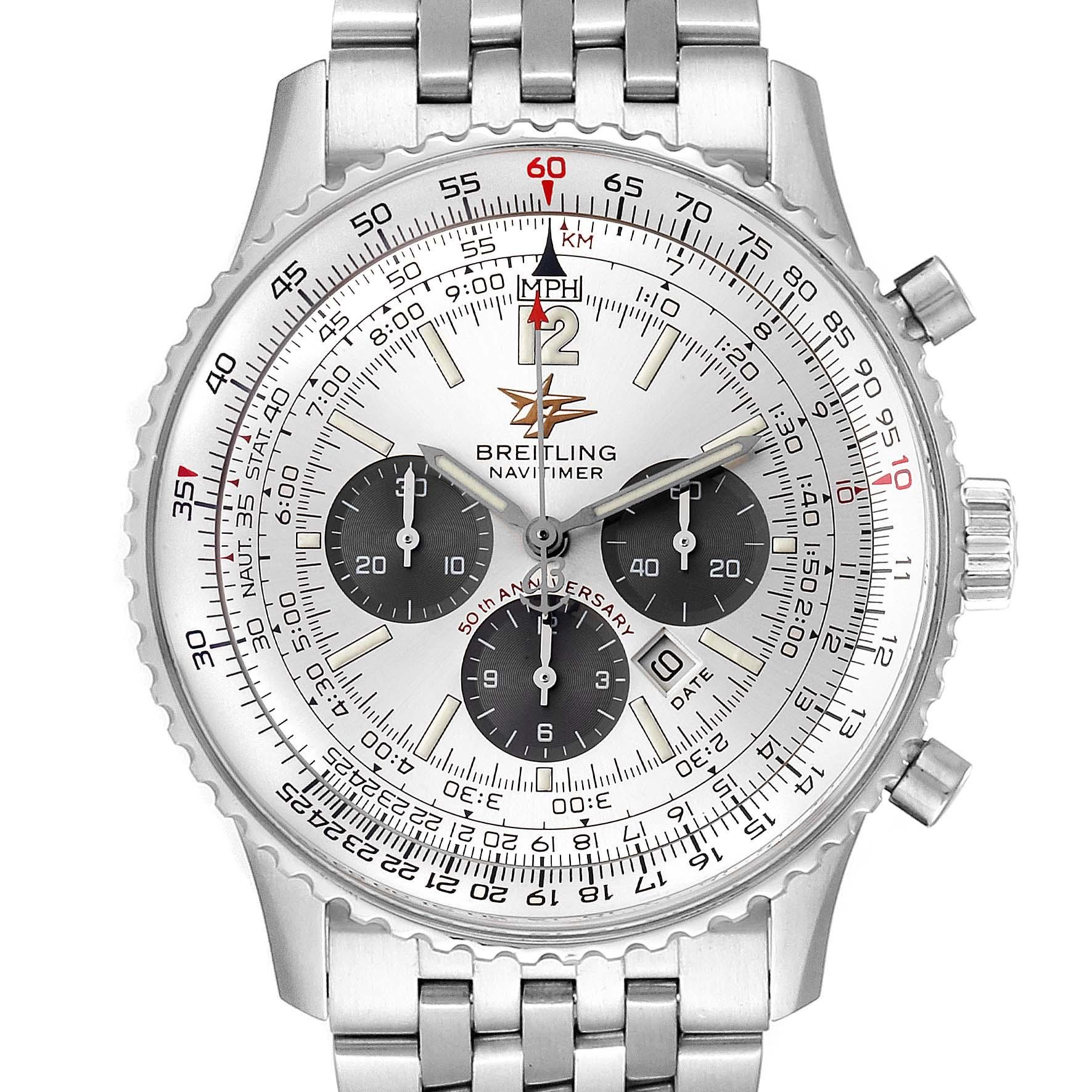
Breitling
Breitling Navitimer 50th Anniversary
Ref. A41322
$3,832
Not in Stock — Estimated Delivery 3–4 Weeks
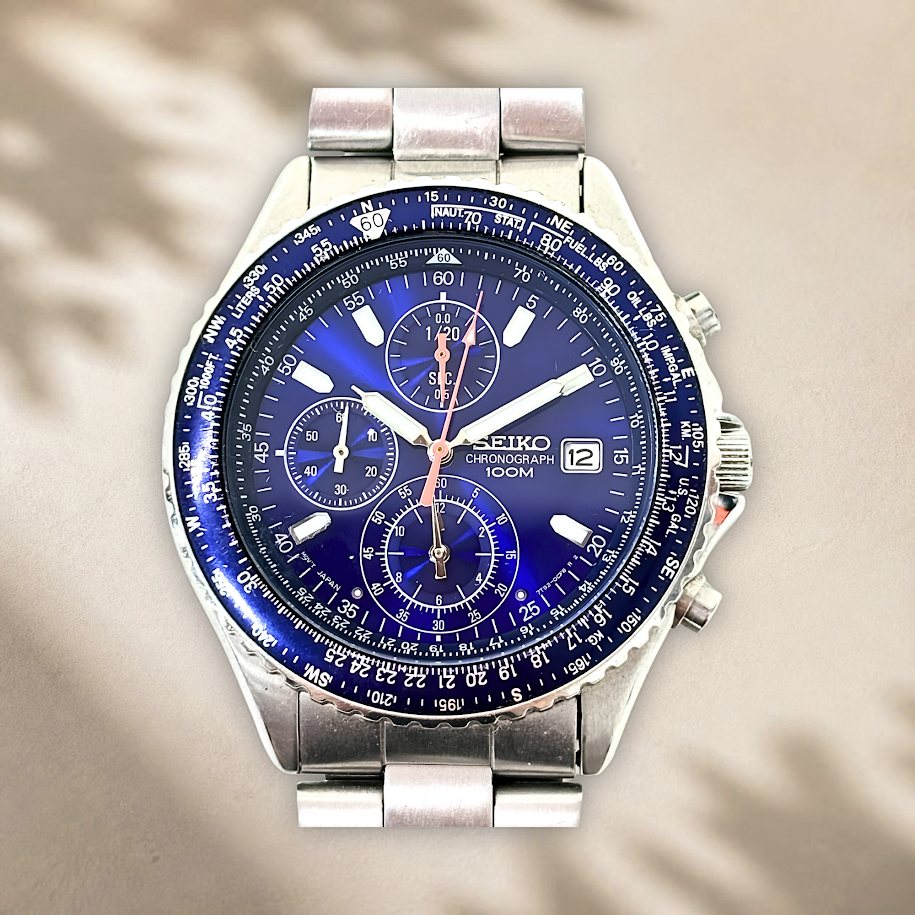
Seiko
Seiko Chronograph 821817 Blue Dial Stainless Steel Watch – Running
Ref. 7T92-0CF0 / SND255
$180
Not in Stock — Estimated Delivery 3–4 Weeks