Blogs / Collector Notes
The Breitling Chrono-Matic Navitimer: The History Behind the Crown on the Left
12 min read · 10/30/2026
Explore the history of the Breitling Navitimer Chrono-Matic, from the Navitimer's 1952 aviation origins to Project 99 and the 1969 Caliber 11 automatic chronograph. This collector-focused guide covers the left-side crown, Ref. 1806 specifications, Caliber 11 and Caliber 12 differences, Ref. 8806, the modern Navitimer B01, and essential vintage-buying advice.
The Breitling Chrono-Matic Navitimer: The History Behind the Crown on the Left
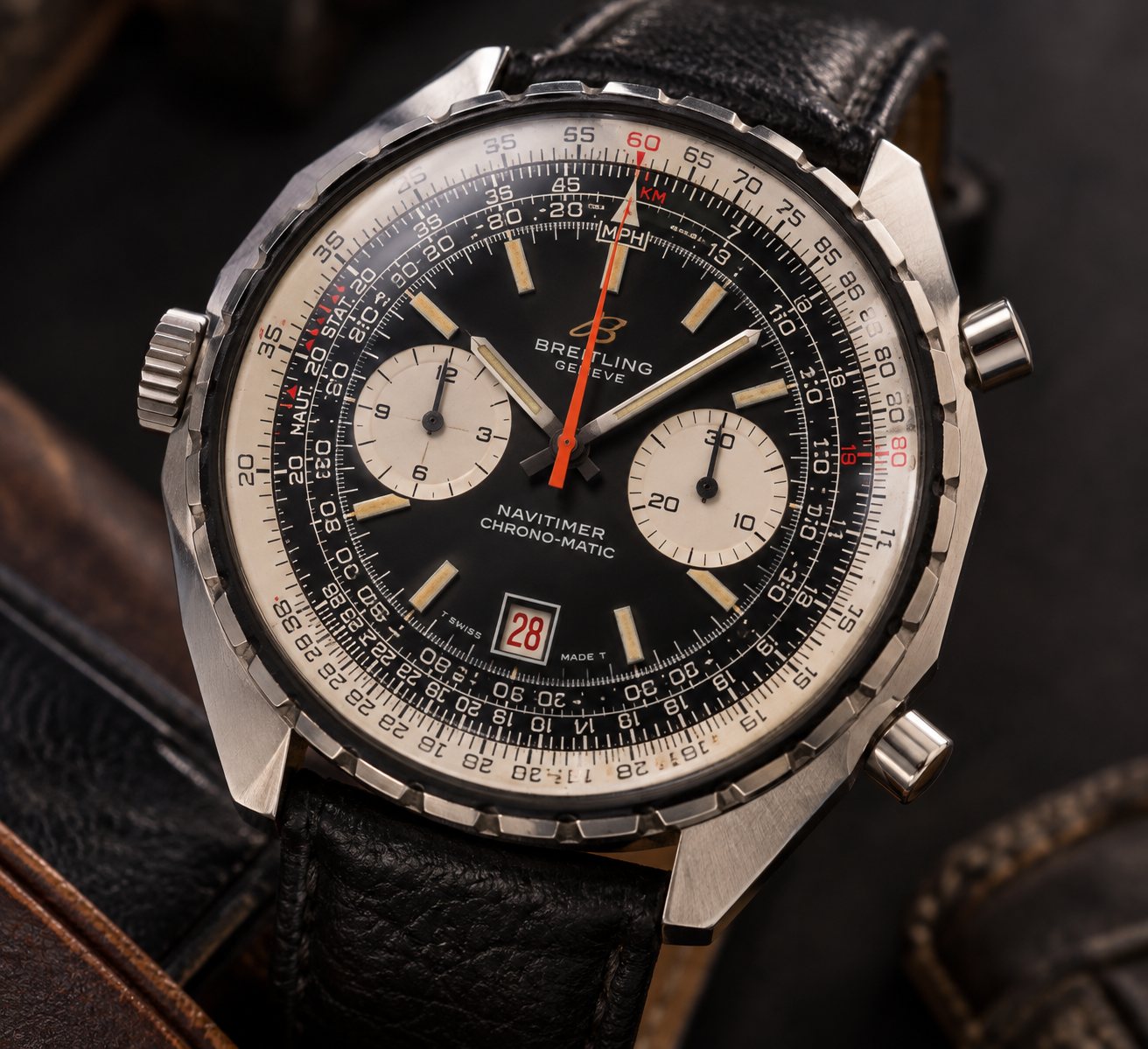
Few vintage chronographs have a silhouette as unmistakable as the Breitling Navitimer Chrono-Matic Ref. 1806. Its broad, angular case, intricate aviation slide rule, and oversized proportions make it stand apart from more conventional chronographs. Then there is the detail that catches the eye of almost every enthusiast: the crown at nine o’clock.
That unusual placement is not merely a styling flourish. It is part of the story of one of watchmaking’s most important technical developments: the arrival of the automatic chronograph.
Introduced in 1969, the Navitimer Chrono-Matic brought a new generation of movement technology into a watch family already closely associated with aviation. The result was a distinctive combination of history, engineering, and design that continues to attract collectors.
To understand why the Chrono-Matic matters, however, we need to look beyond the crown. Its story begins with the original Navitimer, continues through the race to develop an automatic chronograph, and ends with a vintage watch whose identity is inseparable from the technology inside it.
The History of the Navitimer: From Aviation Instrument to Collector's Watch
The Navitimer story began in 1952, when Breitling's Willy Breitling developed a wrist-worn chronograph for the Aircraft Owners and Pilots Association, better known as AOPA.
Pilots needed more than a watch that could tell the time. Flight planning and navigation involved calculations for average speed, distance, fuel consumption, and other essential measurements. Before electronic flight computers became commonplace, a circular logarithmic slide rule was a practical tool for performing these calculations.
Breitling adapted the slide-rule concept for the wristwatch, integrating it into a rotating bezel surrounding the chronograph dial. The name Navitimer combined the ideas of navigation and timing, capturing the watch's intended role as a pilot's instrument.
The original AOPA-associated Navitimer appeared without conventional Breitling branding on the dial. In late 1955, the watch became available to the wider public under the Breitling name, and the reference 806 became central to the model's early history.
Through the following decade, the Navitimer evolved in appearance while retaining its defining combination of chronograph functionality and aviation calculations. Contrasting subdials, changing bezel details, and the introduction of the Twin-Jet logo helped establish the visual language familiar to collectors today.
By the late 1960s, the Navitimer already had a recognizable identity. What it did not yet have was the automatic chronograph movement that would lead to one of its most distinctive variations.
That change was about to transform the watch.
1969: The Race to Create the Automatic Chronograph
In the 1960s, automatic watches were becoming increasingly desirable, while mechanical chronographs generally required manual winding. Combining the two functions in a practical movement was a major engineering challenge.
Several groups pursued the goal, including Zenith, Seiko, and a Swiss collaboration involving Breitling, Heuer-Leonidas, Hamilton-Büren, and Dubois-Dépraz.
The Swiss collaboration became known as Project 99. Its partners brought different specialities to the problem. Breitling and Heuer had established chronograph expertise, Buren had experience with compact micro-rotor automatic movements, and Dubois-Dépraz specialized in modules and complications.
The solution was modular. A Buren automatic base movement was combined with a separate chronograph module developed by Dubois-Dépraz. Rather than designing every function as part of one integrated movement, the partners brought together specialized components to create an automatic chronograph.
On March 3, 1969, the partners announced Caliber 11 at simultaneous press conferences in Geneva and New York. Chronomatic watches subsequently reached the market that year.
This was a landmark moment, but the history deserves nuance. Zenith had publicly presented its El Primero prototype in January 1969, while Seiko's automatic chronograph development followed its own path in Japan. Which achievement counts as the first depends on whether one considers public announcement, production, or retail availability.
For Breitling, the significance is clear. Project 99 made it possible to combine the Navitimer's aviation slide rule with automatic chronograph technology, creating a watch that belonged to a new era without abandoning its original purpose.
Why the Chrono-Matic Has Its Crown on the Left
The left-side crown is the Chrono-Matic's signature feature, but it makes more sense when viewed as an engineering decision rather than an isolated design choice.
Caliber 11 used a modular construction, with the automatic base movement and chronograph mechanism arranged together as a combined assembly. Its layout placed the crown at nine o’clock, while the chronograph pushers remained on the right side of the case.
The arrangement also gave the dial a distinctive configuration. On the original Caliber 11, the 12-hour recorder sits at nine o’clock, the 30-minute recorder at three, and the date window at six. There is no conventional running-seconds subdial.
These details make the movement identifiable even before its name is confirmed. The crown position, register arrangement, and date location all reflect the architecture of the original automatic chronograph.
It is sometimes suggested that Breitling placed the crown on the left primarily to make the watch more comfortable for people wearing it on the left wrist. That may be a welcome effect for some owners, but it is not the best explanation of the design's origins. The movement architecture is the essential part of the story.
For collectors, this is what makes the Chrono-Matic particularly satisfying. Its most recognizable visual feature is connected to the mechanical problem its creators were trying to solve.
The Breitling Navitimer Chrono-Matic Ref. 1806
The Navitimer Chrono-Matic Ref. 1806 was introduced in 1969. Breitling's historical archive lists its case diameter at 47 mm, while some auction catalogues describe individual examples at approximately 47.5 or 48 mm.
Either measurement places it among the more imposing vintage chronographs of its period.
The case is angular and broad, with a rotating aviation slide-rule bezel and a dial that prioritizes information over minimalism. It has the visual character of a tool watch, but the proportions also make it a product of the late 1960s and early 1970s, when watch design was becoming more adventurous.
Breitling's own history explains that the large case was developed in connection with the challenge of combining an inner slide rule with a water-resistant case design. The design objective was ambitious for its time, although that historical intention should never be mistaken for a guarantee of water resistance on a surviving watch.
The 1806 is not a subtle vintage chronograph. Its size, dial density, and asymmetrical controls make it a statement piece. For someone who enjoys watches with a strong design identity, that is part of the attraction.
It is also a reminder that vintage-watch measurements need context. A 47 mm case can feel different depending on lug shape, case thickness, bezel proportions, and wrist size. Photographs reveal the design, but trying one on is the best way to understand how it wears.
Breitling Navitimer Chrono-Matic Ref. 1806: Watch Specifications
- Brand: Breitling
- Collection: Navitimer
- Model: Navitimer Chrono-Matic Big Case
- Reference: 1806
- Introduction: 1969
- Case diameter: 47 mm according to Breitling's historical archive
- Movement family: Breitling Caliber 11, 11i, or 12, depending on the example
- Movement type: Automatic chronograph
- Movement architecture: The original Caliber 11 uses a Buren micro-rotor automatic base with a separate Dubois-Dépraz chronograph module
- Functions: Hours, minutes, chronograph, date, and aviation slide rule, with details varying by movement version
- Original Caliber 11 chronograph layout: 12-hour recorder at nine o’clock, 30-minute recorder at three o’clock, and date at six o’clock
- Crown position: Nine o’clock
- Chronograph pushers: On the right side of the case
- Bezel: Rotating aviation slide-rule bezel
- Case material: Verify against the individual watch
- Dial and hands: Variations and replacement components may exist; confirm the specific example
- Crystal: Verify the fitted crystal
- Water resistance: Do not assume present-day water resistance on a vintage watch
- Strap or bracelet: Depends on the individual example; verify originality and condition
These are reference-level details, not a guarantee that every surviving Ref. 1806 is configured identically. Breitling's archive associates the reference with Caliber 11, 11i, and 12. The exact movement, dial, hands, case, crystal, and accessories should be checked against the watch being considered.
Caliber 11 vs. Caliber 12: The Movement Evolution
Caliber 11 is the movement most closely associated with the 1969 launch. It combined automatic winding and chronograph functionality through modular construction, a practical response to the engineering challenges of the period.
The movement is also notable for its micro-rotor automatic base. Rather than using a large central rotor that covers much of the movement, the micro-rotor sits within the movement's architecture. The chronograph module was developed separately and combined with that base.
Caliber 12 followed with technical revisions, including a higher operating frequency. Specialist references commonly list Caliber 11 at 19,800 vibrations per hour and Caliber 12 at 21,600 vibrations per hour.
For collectors, the distinction is more than a specification detail. It helps place an individual watch within the evolution of the Chrono-Matic family.
It is important, however, not to identify a movement solely from the dial or reference number. A Ref. 1806 may be associated with more than one caliber, and the condition of a vintage watch cannot be determined by movement designation alone.
Before buying, request clear movement photographs and ask about service history. A watchmaker familiar with vintage automatic chronographs can assess the movement, winding system, chronograph operation, date mechanism, and general condition.
A running watch is not necessarily a healthy one. Correct operation and documented maintenance are important parts of evaluating a vintage Chrono-Matic.
Ref. 1806 vs. Ref. 8806: Two Different Chrono-Matic Navitimers
Collectors researching the Chrono-Matic Navitimer should distinguish the large-case Ref. 1806 from the smaller Ref. 8806.
Breitling's historical archive lists the Navitimer Chrono-Matic Mk10 Ref. 8806 for 1974, with a case diameter of approximately 40.3 mm and Caliber 12.
The difference in size changes the character of the watch considerably. The Ref. 1806 is defined by its oversized case and bold presence. The Ref. 8806 offers the Chrono-Matic connection in a more compact format.
Neither is automatically the better choice. The right reference depends on personal taste, wrist fit, and the condition and originality of the specific watch.
This distinction is especially important when buying online. The reference, case dimensions, movement, and photographs should tell a consistent story. If the listing details do not match, ask for clarification before making a decision.
Vintage Chrono-Matic vs. the Modern Navitimer B01
The modern Navitimer B01 continues the aviation slide-rule and chronograph tradition, but it represents a different generation of watchmaking.
The vintage Ref. 1806 is compelling because of its place in the early automatic-chronograph era. Its modular movement architecture, left-side crown, and oversized case give it a personality rooted in the late 1960s and early 1970s. Its ownership experience, however, depends heavily on the condition of the individual example.
The modern Navitimer B01 uses Breitling's manufacture Caliber 01. For the current 46 mm B01 Chronograph, Breitling lists an approximately 70-hour power reserve and a frequency of 28,800 vibrations per hour. The current model also offers modern manufacturing, contemporary materials, and the applicable brand warranty and servicing support.
The choice comes down to priorities. The vintage Chrono-Matic suits a collector drawn to historical character and the engineering story of 1969. The modern B01 may be a more straightforward option for someone who wants a contemporary Navitimer for regular wear.
One is not a replacement for the other. The B01 represents the modern continuation of the Navitimer design; the Chrono-Matic preserves a distinctive chapter in its development.
See the official Breitling Navitimer B01 Chronograph 46 specifications.
What to Check Before Buying a Vintage Chrono-Matic Navitimer
Vintage chronographs should be evaluated as individual watches, not simply by reference number or appearance.
- Reference and movement: Confirm the reference and request clear movement photographs. Verify the caliber where possible.
- Dial and hands: Look for refinishing, replacement parts, inconsistent aging, or components that may not match the reference. Service parts are not automatically a problem, but they should be disclosed.
- Case condition: Examine the case from several angles. Heavy polishing can soften original edges and reduce the definition of the angular case.
- Chronograph operation: Confirm that the chronograph starts, stops, and resets correctly.
- Time-setting and date: Check the crown, setting mechanism, and date function for correct operation.
- Service history: Ask when the watch was last serviced and request supporting records where available. Unknown service history should be treated as a potential maintenance expense.
- Water resistance: Do not assume the watch is safe around water. If this matters, have it assessed by a qualified watchmaker.
- Photographs and disclosure: Request clear images of the dial, case sides, caseback, movement, and accompanying documents.
Originality deserves a balanced assessment. A vintage watch can have legitimate replacement parts from servicing and still be a desirable collectible. The important questions are what has been replaced, whether the work was appropriate, and whether the seller describes the watch accurately.
The best purchase is not necessarily the one with the cleanest dial or the most dramatic patina. It is the one whose condition, originality, service needs, and price make sense together.
Is the Breitling Chrono-Matic Navitimer Worth Collecting?
The Navitimer Chrono-Matic Ref. 1806 brings together several important strands of watch history: the original Navitimer's aviation purpose, the race to develop an automatic chronograph, modular movement engineering, and a bold case design that remains instantly recognizable.
The left-side crown is the feature most people notice first, but it is only the beginning. It reflects the movement architecture that helped shape the watch, while the aviation slide rule connects it to the Navitimer's original role as a pilot's instrument.
For collectors, the appeal lies in that combination of history and design. For buyers, historical importance is only part of the decision. Correct identification, condition, originality, service history, and the quality of the seller's description all influence whether a particular example deserves serious consideration.
At The Aviators Watch, we believe a good watch purchase begins with understanding what makes the watch special and what to look for in the individual piece. If the Chrono-Matic has caught your eye, explore our available watches or contact us to discuss the reference and the details worth checking before you buy.
A great vintage chronograph should offer more than a story about the past. The right example should be a watch you are happy to own, wear, and keep learning about for years to come.
Watches in this story
Breitling
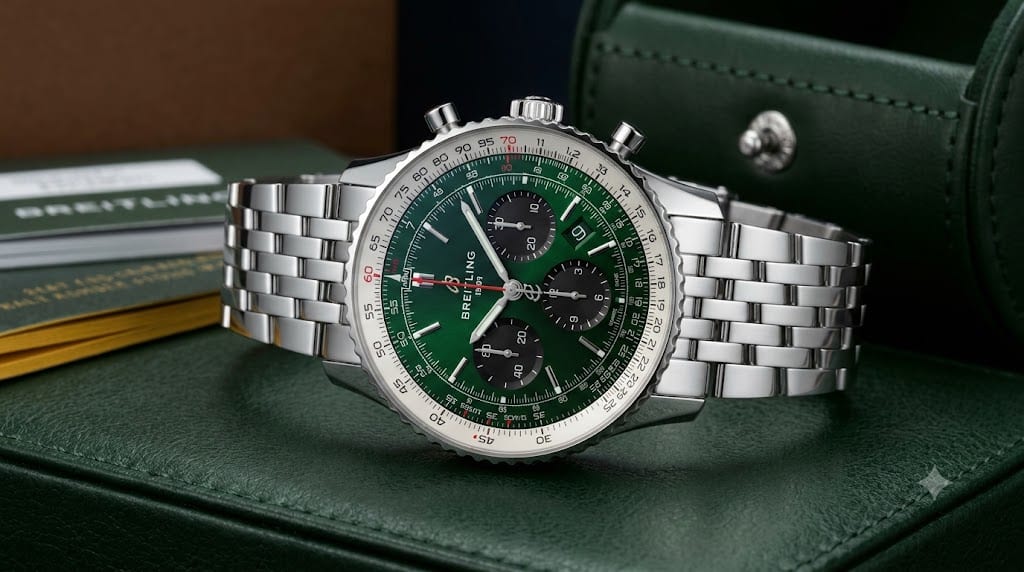
Breitling Navitimer 1 B01 Chronograph Green
Ref. AB0127
$7,500
Not in Stock — Estimated Delivery 3–4 Weeks
Breitling
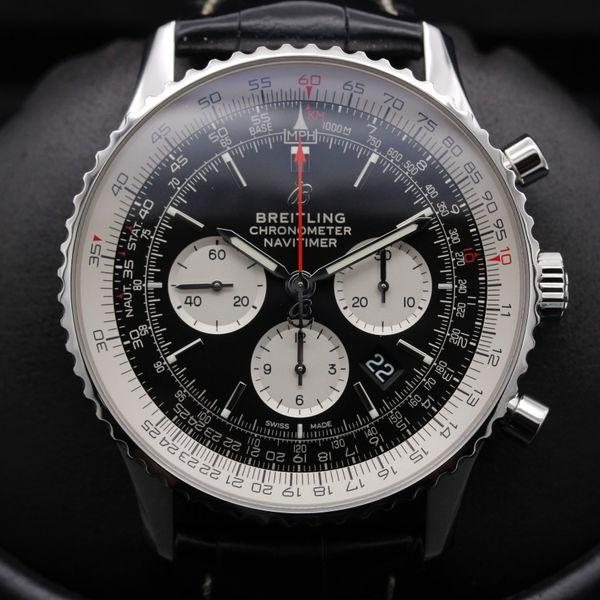
Breitling Navitimer 1 B01 Chronograph 46
Ref. AB0127
$5,161
Not in Stock — Estimated Delivery 3–4 Weeks
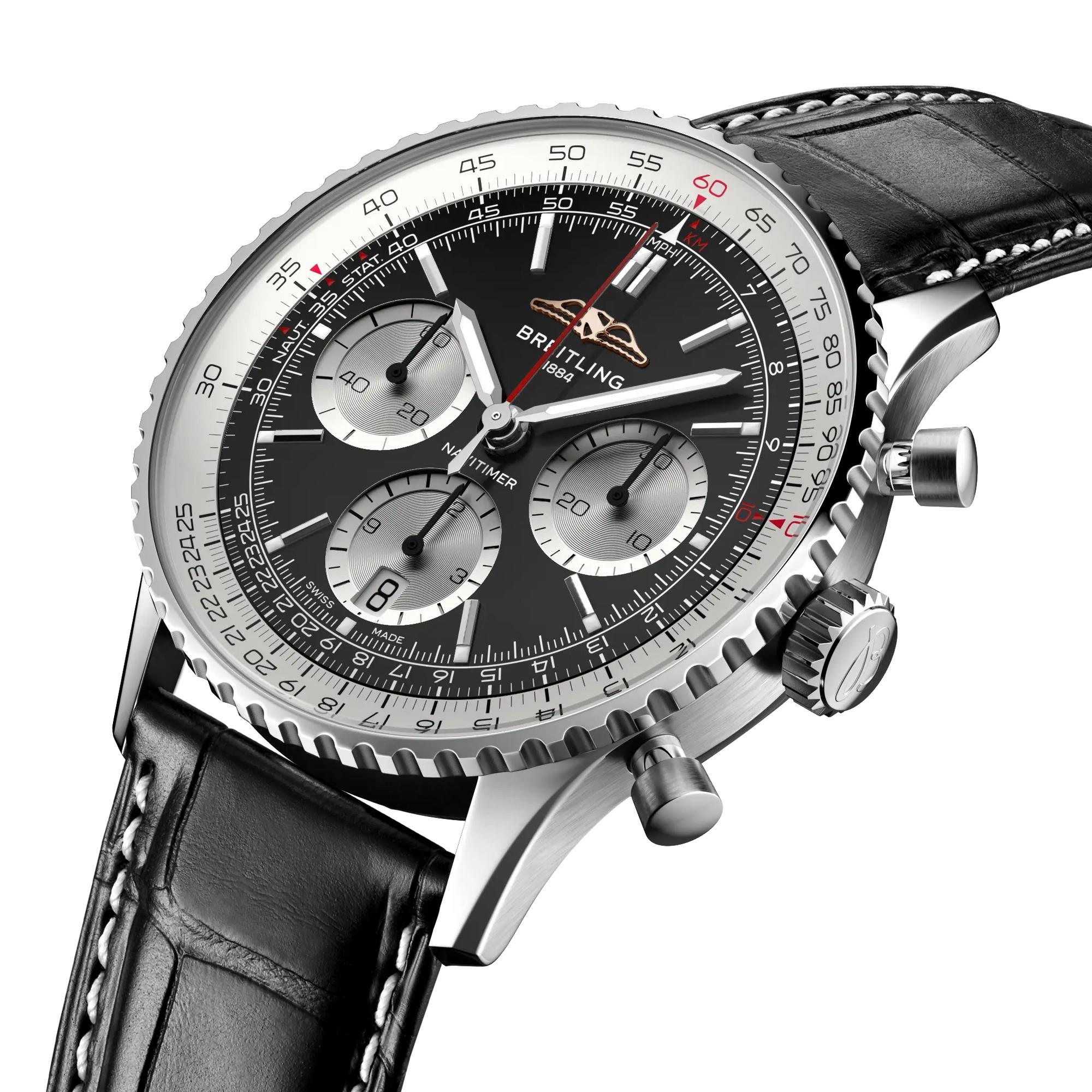
Breitling
Breitling Navitimer B01 Chronograph 46
Ref. AB0137
$5,956
Not in Stock — Estimated Delivery 3–4 Weeks