Blogs / Buying Guides
The Tiny Side of Vintage Omega: When Elegance Mattered More Than Size
7 min read · 10/8/2026
A remarkably small vintage Omega demonstrates a side of watchmaking that modern collectors often overlook. Measuring approximately 21.3 mm across in the photographed measurement, this manually wound watch combines a finely textured dial, sculpted case and elaborate bracelet architecture in a design where miniature mechanical engineering and jewelry came together.
The Tiny Side of Vintage Omega: When Elegance Mattered More Than Size
When most people picture a vintage Omega today, they probably imagine a Speedmaster, Seamaster, Constellation, or perhaps a classic men's De Ville.
But Omega's history is much broader than the watches that dominate today's collector market.
This remarkably small manual wind Omega is a perfect example.
Measuring only about 21.3 mm across in the measurement shown, it seems almost impossibly small by modern standards. Yet its diminutive dimensions are only part of the story.
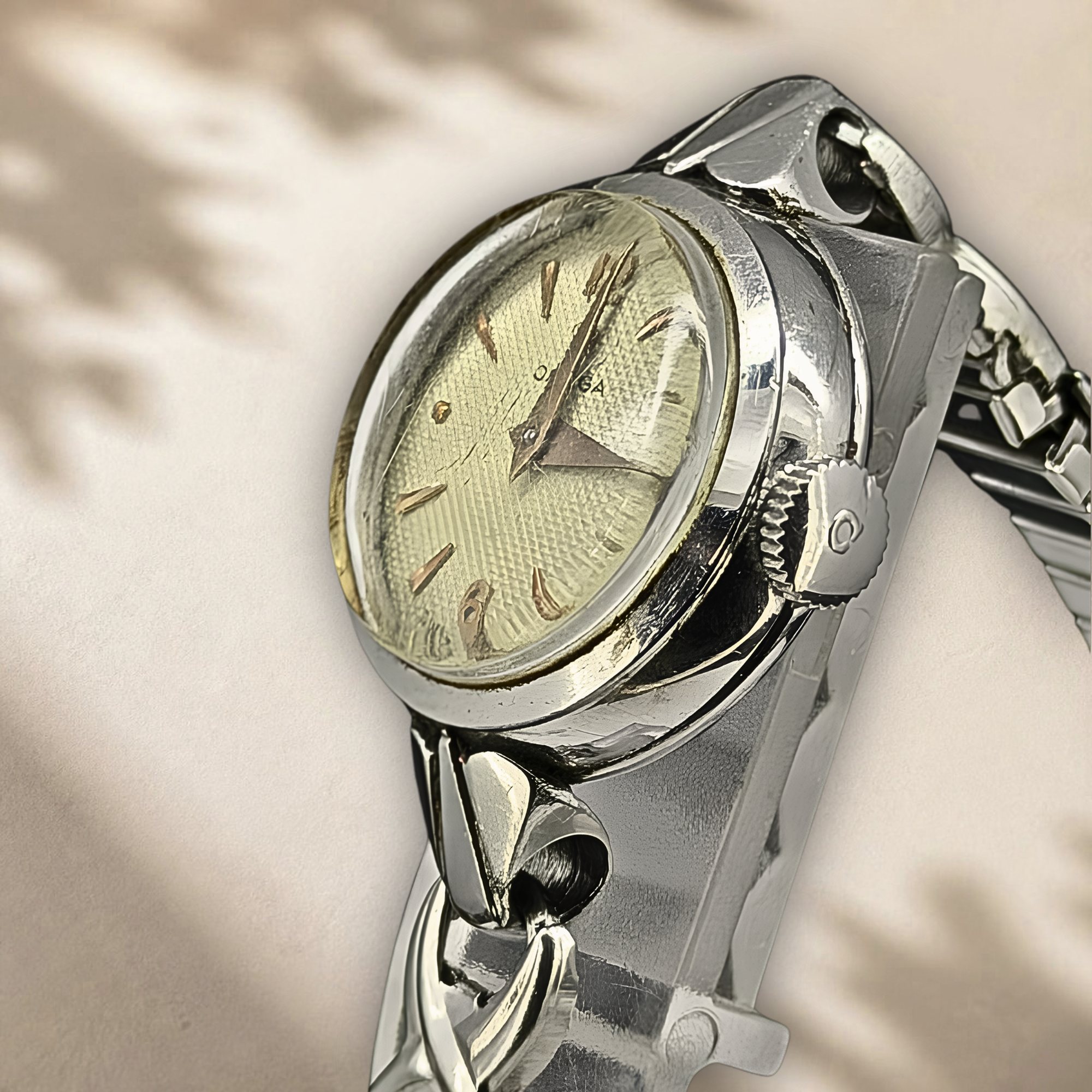
Look closely and this is an extraordinarily elaborate little watch.
Small Watch, Remarkable Detail
At first glance, the size is what gets your attention.
At roughly 21 mm across, the watch is dramatically smaller than the 36 to 40 mm watches many people now consider conventional.
But enlarge the photograph and the details begin to emerge.
The dial has a finely textured surface rather than a simple flat finish. Applied hour markers catch the light around its perimeter, while the Omega name occupies a remarkably restrained position beneath twelve o'clock.
Even the hands contribute to the design. Rather than oversized hands intended for maximum legibility, they are slender and elegant, matching the scale and purpose of the watch.
Nothing about the design suggests that Omega was trying to make the watch appear larger than it was.
Its small size was part of its elegance.
The Case Is Where Things Get Interesting
Turn the watch slightly and the architecture becomes much easier to appreciate.
The case is dramatically sculpted, particularly around the lugs.
Instead of four simple projections holding a conventional strap, the watch transitions into an ornate bracelet through decorative, highly dimensional end pieces.
Viewed from the side, those structures almost overwhelm the tiny watch itself.
The result is closer to jewelry incorporating a precision timepiece than a modern wristwatch with a bracelet attached to it.
That distinction is important when trying to understand watches from this period.
Today we tend to evaluate watches primarily by specifications: diameter, movement, water resistance, power reserve and complications.
A watch like this was designed according to a different set of priorities.
Proportion. Decoration. Elegance. Jewelry.
And, of course, timekeeping.
A Mechanical Movement in a Very Small Space
Another detail makes the watch especially interesting.
It is manually wound.
There is no battery hidden inside this tiny case. The watch belongs to an era when producing a very small mechanical wristwatch required manufacturers to engineer correspondingly small mechanical movements.
The wearer periodically winds the movement using the crown, storing energy in its mainspring. That stored energy then powers the mechanical gear train and escapement.
It is easy to overlook just how impressive that becomes at this scale.
A mechanical watch movement already contains numerous tiny interacting components. Reducing the entire mechanism enough to fit inside a case barely more than two centimeters across creates another level of engineering challenge.
That makes vintage miniature mechanical watches fascinating objects even when they fall outside the categories currently receiving the most collector attention.
When Women's Watches Were Designed Differently
This watch also illustrates how dramatically wristwatch tastes have changed.
For much of the twentieth century, women's watches were often intentionally very small.
The objective wasn't wrist presence.
It was discretion.
A fine wristwatch could function almost like another piece of jewelry, complementing a bracelet rather than dominating the wrist.
That philosophy explains why manufacturers put considerable effort into elaborate cases and bracelets surrounding movements that were astonishingly small.
Omega has a long history in women's watchmaking, with the brand itself tracing that side of its watchmaking heritage back more than a century. :chatgpt-content-reference{index="1"}
Today, women routinely wear watches in a much wider range of sizes. Vintage examples like this therefore provide a physical record of changing fashion as much as changing watchmaking technology.
Look Beyond the Dial
One reason we enjoy handling vintage watches at The Aviators Watch is that photographs rarely tell the whole story at first glance.
This Omega is a particularly good example.
Look only at the dial and you see a tiny old watch.
Look at the side profile and suddenly the case construction becomes the star.
Look closer at the dial and its texture appears.
Examine the bracelet and you discover another layer of decorative design.
Then remember that beneath that tiny dial is a mechanical movement that was designed to be wound and operated from the equally tiny crown.
Each observation reveals another part of the object.
Condition Tells Part of the Story
This particular example clearly shows its age.
The crystal displays substantial wear, and the case and bracelet have accumulated the marks expected from decades of use. The dial also deserves close examination when assessing originality and condition.
We think those details should be shown rather than hidden.
Vintage watches aren't new watches.
Wear can tell us how a watch was used, while replacement parts, refinishing, polishing and restoration can sometimes tell us what happened to it afterward.
Determining which components remain original can be especially important when evaluating vintage Omega watches.
Without examining the movement, inside case markings and reference information, we would also avoid assigning an exact production year or caliber to this example.
That is preferable to turning an educated guess into a supposed fact.
Why Small Vintage Omegas Are Worth Studying
Collector demand naturally gravitates toward certain watches.
Large men's sports watches currently receive an enormous amount of attention, and that attention influences prices.
But historical importance and current market popularity aren't necessarily the same thing.
A tiny manual wind Omega represents a type of watchmaking that has largely disappeared.
Manufacturers no longer need to construct miniature mechanical movements simply to make a small women's watch. Quartz technology can accomplish the same basic function far more easily and inexpensively.
That makes these older mechanical watches artifacts of a particular period in watchmaking.
They show what was possible when miniature mechanical engineering and jewelry design were expected to coexist in the same object.
The Art of Miniaturization
Miniaturization is one of the easiest aspects of vintage watchmaking to overlook.
A larger movement has more physical space for components, while a very small mechanical movement has to achieve the same fundamental task within a dramatically reduced footprint.
That makes miniature watches interesting from an engineering perspective even when their movements are mechanically simple compared with larger complications.
The challenge isn't necessarily how many functions the watch has.
Sometimes the achievement is simply making everything work at such a small scale.
That is part of what gives this Omega its character.
Don't Judge a Vintage Watch by Its Diameter
Perhaps the most interesting lesson from this Omega is also the simplest.
Size and complexity aren't the same thing.
A 21 mm watch can contain just as much history as one twice its diameter.
Sometimes more.
This little Omega combines traditional mechanical watchmaking with the design language of fine jewelry. Its tiny dial, textured surface, elaborate case, decorative bracelet and manual wind movement belong to a period when manufacturers approached women's watches very differently than they do today.
It may never command the attention given to a vintage Speedmaster.
But that isn't really the point.
At The Aviators Watch, part of the enjoyment of vintage watches is discovering the pieces that make you stop and ask:
Why did they make it like that?
Those questions often lead to the most interesting stories.
And this tiny Omega certainly has one to tell.
Final Thoughts
This remarkably small Omega is a reminder that vintage watchmaking cannot always be understood through modern measurements and collector trends.
At roughly 21.3 mm across in the photographed measurement, it may appear tiny by today's standards.
But its textured dial, sculpted case, elaborate bracelet and manual wind movement reveal an object designed around a very different idea of elegance.
It wasn't trying to dominate the wrist.
It was trying to complement it.
And perhaps that is exactly why this little Omega remains so fascinating decades later.
Sometimes the smallest watches have the biggest stories.