Blogs / Collector Notes
Tudor vs. Rolex GMT-Master: The Shared DNA That Makes Collectors Look Twice
7 min read · 10/13/2026
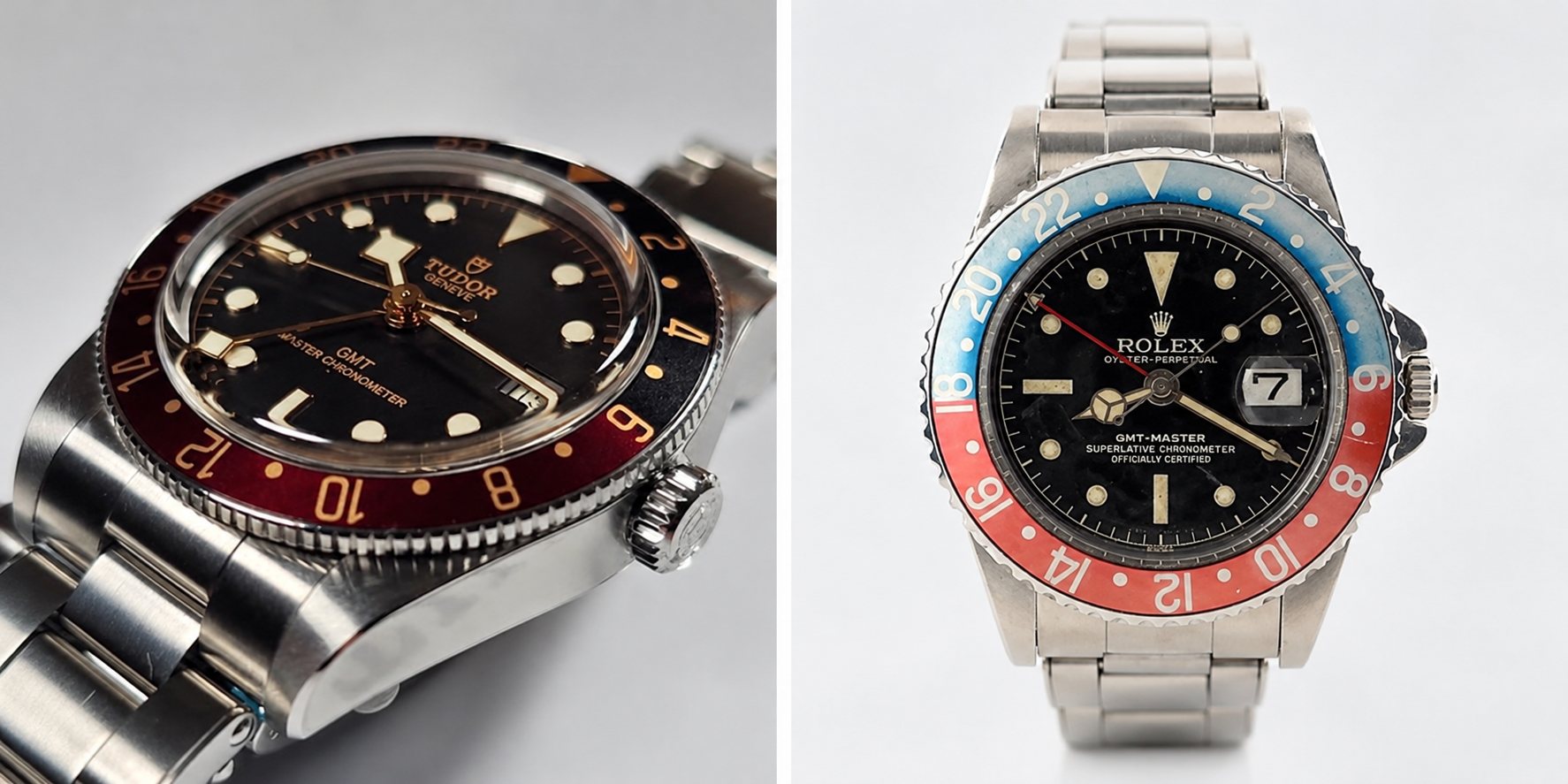
Explore the historical connection between vintage Tudor and Rolex watches, comparing their shared design language, distinctive features, movements, and collector appeal. Discover what makes the Rolex GMT-Master 1675 an aviation icon and why vintage Tudor sports watches deserve recognition in their own right.
The Rolex GMT-Master: A Watch Built for a World in Motion
The Rolex GMT-Master emerged in the 1950s, when long-distance commercial aviation was changing how people traveled and worked. Pilots and international travelers needed a practical way to keep track of time at home while crossing time zones.
The solution was elegant. An additional 24-hour hand worked with a rotating bezel marked for 24 hours, allowing the wearer to read another time zone alongside conventional local time. The two-tone bezel made the display easier to interpret, with the red-and-blue combination becoming one of the watch's most enduring signatures.
The reference 1675, introduced in 1959 and produced until approximately 1980, became one of the defining vintage GMT-Master references. Across its long production life, it appeared with different dial styles, hand configurations, bezels, and movement variations.
That evolution is one reason collectors love the 1675. Two watches can share the same reference number and still have meaningful differences. A small detail in a dial, a particular bezel insert, or the shape of a hand can tell a knowledgeable collector something about the watch's history.
Vintage Tudor: Familiar Design, Its Own Identity
Tudor's relationship with Rolex is central to understanding why some of its vintage watches feel so familiar. Founded by Hans Wilsdorf, Tudor was developed as a more accessible watchmaking proposition, while maintaining an emphasis on dependable construction and practical design.
Historically, certain Tudor models shared cases, bracelets, crowns, or other components associated with Rolex production. The precise relationship depended on the model and period, so it would be misleading to assume every vintage Tudor shared all the same parts.
Still, the family resemblance can be fascinating. A vintage Tudor sports watch may have the same confident steel proportions, the same purposeful tool-watch attitude, and a similar sense of restraint that collectors admire in vintage Rolex models.
But Tudor was never merely a different name printed on a Rolex dial. Its watches used their own model references and, in many cases, different mechanical movements. Tudor's own design details also developed over time, giving collectors a distinct family of watches to explore.
The Resemblance: What Makes Collectors Look Twice?
The Case and Bracelet
Vintage sports watches often share a practical design vocabulary. Steel cases, protective crown guards on applicable models, robust lugs, and bracelet connections create a familiar silhouette.
On certain vintage Tudor and Rolex watches, those similarities are especially noticeable because of their historical relationship. Yet even when two cases look nearly identical in a photograph, their reference numbers, manufacturing details, and condition should be checked independently.
Dials That Put Legibility First
There is a reason classic sports watches remain so appealing. Their dials are designed to be read quickly. Clear hour markers, strong contrast, and purposeful hands make them useful tools rather than merely decorative objects.
Vintage Tudor and Rolex models often share this practical philosophy, although their exact marker shapes, hand styles, logos, and dial layouts vary by reference.
Bezels With a Purpose
The bezel is where the comparison becomes especially interesting, because similar-looking components can perform entirely different jobs.
On the Rolex GMT-Master, the 24-hour bezel works with the additional GMT hand to display another time zone. Its red-and-blue Pepsi insert is not just a color choice. It is part of the watch's practical design and its aviation identity.
A vintage Tudor may have a rotating dive bezel, a fixed bezel, or another configuration depending on the model. Similar proportions or colors do not automatically mean that it provides the same GMT function.
The Details That Reveal Their Differences
Collectors look at the crown, caseback, dial printing, hands, movement, and the relationship between all these components. On vintage watches, a replacement dial, service hand, polished case, or aftermarket component can affect originality and collector appeal.
Neither matching patina nor a convincing appearance proves originality by itself. The watch must be evaluated as a complete object, with its reference, movement, condition, and service history taken into account.
Function Is Where the Comparison Must Be Honest
The Rolex GMT-Master was designed to display another time zone. Its additional 24-hour hand and rotating bezel are central to its identity, and the GMT-Master II later introduced an independently adjustable local hour hand for easier time-zone changes.
Vintage Tudor models cover a wider range of purposes. Some were designed as dive watches, some as everyday sports watches, and others served entirely different roles. Their functions depend on the specific reference.
This means a vintage Tudor can be a compelling alternative for someone who loves the look of classic Rolex sports watches without necessarily being a functional substitute for a GMT-Master.
Movements: The Story Beneath the Dial
A vintage watch can look familiar on the outside while being quite different inside. Rolex GMT-Master references used different movements over their production history, while Tudor used a range of mechanical calibers across its own collections.
The movement determines the functions available, the way the watch is serviced, the parts required for maintenance, and the expertise needed to keep it running correctly. For a vintage purchase, the movement should be checked by a qualified watchmaker and verified against the claimed reference and production period.
Price, Collectability, and the Pleasure of Finding the Right Watch
There is no universal price difference between vintage Tudor and Rolex. A Rolex GMT-Master can command a significant premium because of its history, demand, and collector recognition, but the final value depends heavily on the specific reference and configuration.
Vintage Tudor prices vary according to model, originality, condition, rarity, and current demand. A Tudor is not automatically a bargain, and a Rolex is not automatically a better purchase simply because it costs more.
The most meaningful comparison is between two actual watches. Are their condition and originality comparable? Do they have the same level of documentation? Has either been serviced? Are the parts correct for the reference? And what have genuinely comparable examples sold for recently?
For a retailer sourcing watches for resale, the calculation has another layer. The wholesale price must leave room for authentication, servicing, shipping, transaction fees, and a realistic selling price. A desirable watch is not necessarily a profitable acquisition if the numbers do not work.
What to Check Before Buying a Vintage Example
- Reference and serial: Confirm the identifying details and whether they are consistent with the claimed model and period.
- Dial and hands: Examine printing, lume, hand shape, and any signs of refinishing or replacement.
- Bezel: Establish whether the insert is original, a period-correct replacement, a later service component, or aftermarket.
- Case and bracelet: Check for excessive polishing, softened edges, damage, and bracelet stretch.
- Movement: Verify the caliber, condition, and consistency with the watch's reference.
- Service history: Request available records and budget for maintenance when the history is unknown.
- Authenticity: Seek a qualified assessment, particularly when the watch is expensive or has unusual components.
- Realistic pricing: Compare the exact reference and configuration with credible completed sales, not just optimistic asking prices.
So, Is Tudor the Alternative to Rolex?
Sometimes, yes. But the more interesting answer is that Tudor offers a different route into the world of vintage watch collecting.
For the buyer who specifically wants the Rolex GMT-Master, a Tudor cannot replace the history of that particular watch or its exact combination of features. The GMT-Master has earned its place through decades of aviation heritage, evolving references, and a design that remains unmistakable.
For someone drawn to classic steel sports watches, however, a well-chosen vintage Tudor may offer exactly the qualities they love: purposeful design, mechanical character, historical connections, and details that reward close inspection.
Final Thoughts: Look Beyond the Name on the Dial
Vintage Tudor and Rolex watches are fascinating precisely because their stories overlap without being identical. Their historical connections help explain the resemblance, but their individual references, movements, and design details give each watch its own identity.
The Rolex GMT-Master remains a landmark of aviation-inspired watchmaking. Its 24-hour display and Pepsi bezel have become enduring symbols of a world made smaller by air travel. Vintage Tudor, meanwhile, offers its own collection of watches shaped by the same era of practical, purposeful design.
For an enthusiast, the fun is in looking closer. Study the case. Follow the lines of the hands. Examine the bezel. Learn the reference. Ask what is original and what has changed. A watch that first caught your eye because it looked familiar may become much more interesting once you understand its individual story.
Explore Available Watches
Discover the vintage watches available from The Aviators Watch. Review each watch's reference, condition, movement, originality, and asking price, and contact us for further details before making a purchase.
Watches in this story